Do You Need a Miter Saw as a Beginner? (And When)
What a miter saw is genuinely for, the footprint nobody mentions, the hand placement rule from the manuals, and the cuts that belong elsewhere.

Not at the start, and in a small home possibly not at all. A miter saw does one thing superbly: it crosscuts a board to a repeatable length and angle, again and again, fast. If you are building single objects from a handful of parts, a hand saw in a miter box or a circular saw against a square gets you the same cuts. The saw earns its place when the count of identical cuts goes up.
Its real cost is not the purchase. It is the space the saw needs while it is working, and it is a bigger number than the machine's own footprint.
What the Tool Is Actually For
A miter saw is a circular saw blade on a hinged arm above a table and a fence. The wood stays still, the blade comes down. That is the whole idea, and it produces two advantages nothing else matches.
Repeatability. Set a stop block at a distance from the blade and every part comes off at that length, without measuring twice. For a set of shelf supports or four frame sides, that is the difference between parts that fit and parts that nearly fit.
Angles you can dial in. The table swings for miters and, on a compound saw, the head tilts for bevels. Set the angle once and every cut matches.
What it cannot do is anything long or wide. It cannot rip a board to width, it cannot break down a sheet of plywood, and its crosscut width is limited by the model. The capacity table for 90 degrees and 45 degrees is published by the maker for each saw, and that table, not the blade diameter, is the specification that tells you whether it can cut your stock.
The Footprint Nobody Puts in the Listing
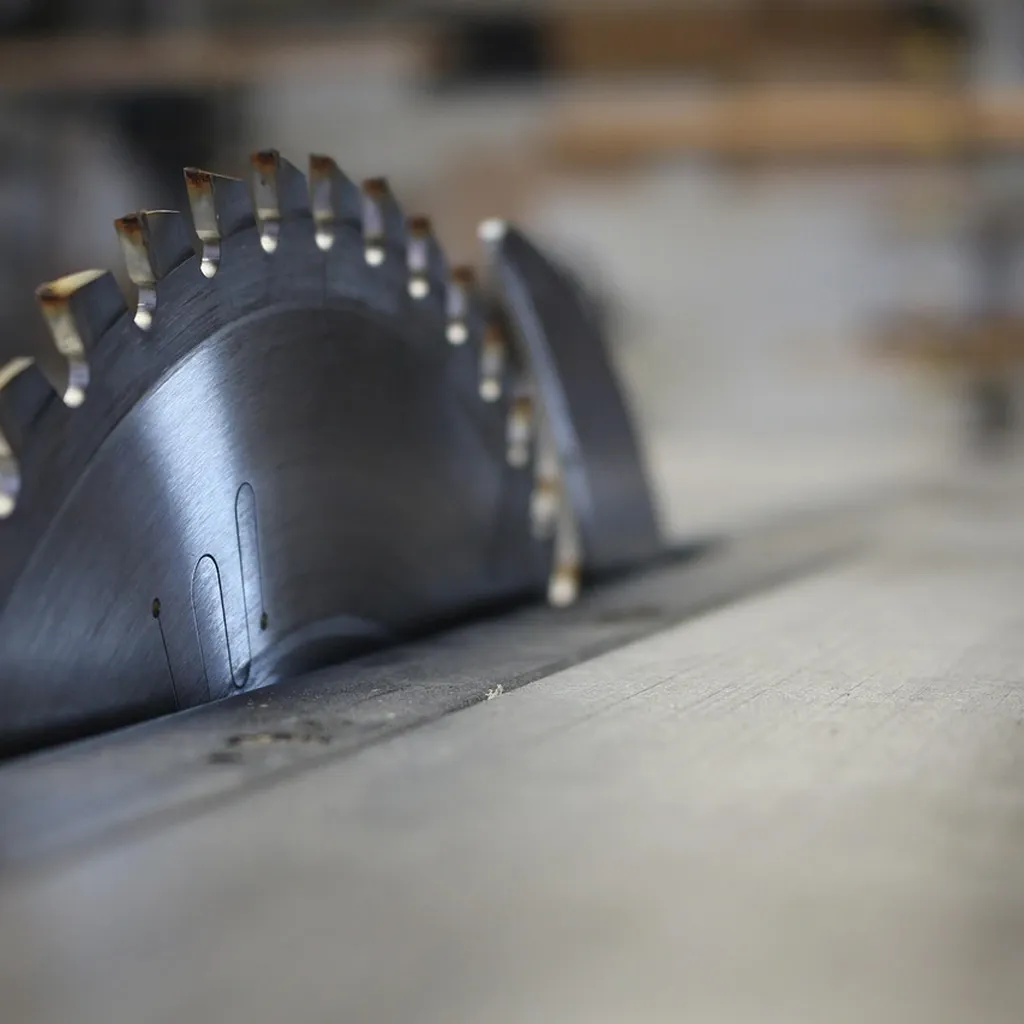
The machine is compact. The workstation is not.
To cut a 2.4 m board in half, you need 2.4 m of clear line through the saw, plus support at both ends at exactly the height of the saw's table. A board that droops off the end lifts off the table during the cut, which is both an accuracy problem and a safety one. A sliding saw also needs clearance behind it for the rails, unless the model is designed to work against a wall.
In practice the saw needs a length of room, not a corner of one. That is a different question from where the tool is stored, and it is the reason miter saws end up living in hallways and on balconies. Work it out honestly against your actual room using the approach in how much space woodworking really needs, before the box arrives.
The dust story is worse than the space story. A miter saw fires chips and fine dust in an arc behind the blade, and the bag fitted to most saws catches a fraction of it. Indoors it coats a room. Outdoors it goes over a balcony rail onto someone else's washing, which is the neighbor problem covered in woodworking around roommates and neighbors.
Hand Placement, Which Is the Whole Safety Story
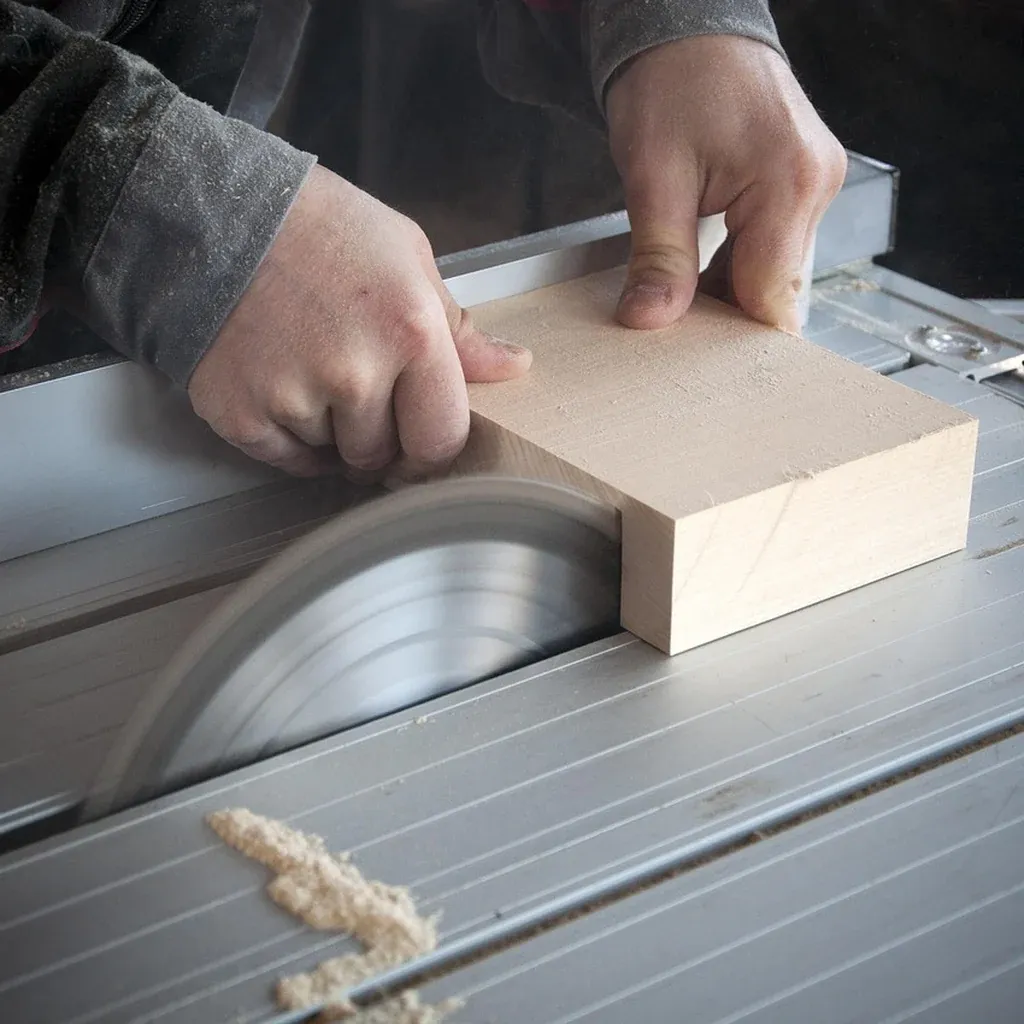
A miter saw feels safe because the blade comes to the wood and the wood stays put. The injuries come from where hands are while that happens.
Keep your hands out of the blade's path, and keep them well clear of it. DeWalt's miter saw instruction manuals state that hands must not be placed closer than 6 inches to the blade, and Makita's manuals carry the same instruction to keep hands out of the blade's path. Your saw's own manual gives the figure for your saw, and it is worth reading once rather than assumed.
Never reach across the blade. Hold the work on the left of the blade with your left hand and on the right with your right hand. Crossing an arm over a spinning blade to steady an offcut is the classic serious injury on this machine, and it happens on the cut people think is trivial.
Let the blade stop before you lift the head, and before you move anything. A coasting blade lifted out of the kerf can pull the workpiece or the offcut with it. Do not pick up an offcut near the blade until it has stopped.
Clamp what you can. Most saws have a hold-down clamp; use it. A board held only by hand can shift or climb the fence.
Cuts That Belong Somewhere Else
The stop conditions are specific on this tool, and the manual for your saw states them.
Short pieces have a minimum length, and it is in the manual. Below it, your fingers are inside the danger zone and the offcut can be caught by the blade and thrown. The right method is to cut the part from a longer board, with the waste on the offcut side, then trim. If a piece is genuinely too small to hold safely, it goes in a hand saw and a miter box instead.
Bowed or cupped stock is a trap. Place a bowed board crown up against the fence so it cannot rock, and never cut a board that does not sit flat on the table and flat against the fence. If it rocks, the blade can bind and the board can jump.
No freehand cuts. If the workpiece is not against the fence, the blade will grab it and rotate it. There is no version of a freehand cut on this machine that is worth the outcome.
Sliding saws are pushed away, not pulled toward you. Pull the head fully out, lower it into the wood at the front, then push it back through the cut. Cutting on the pull stroke lets the blade climb up onto the workpiece and toward you.
And the guard: the lower blade guard retracts as the head comes down and must return by itself. If it sticks, the saw is not used until it is fixed.
What to Use Instead, Honestly
The alternatives are real and they cover more of a beginner's work than tool marketing suggests.
A miter box and a hand saw. A plastic or metal box with slots at fixed angles guides a saw at 90 and 45 degrees. It is slow, it is silent, it costs very little, and it is accurate enough for frames and small boxes. That is the whole argument of the guide to building a picture frame without a miter saw, which walks through the method and where it goes wrong.
A circular saw and a speed square. For crosscutting boards to length, a square clamped or held firmly against the edge guides the saw's baseplate. It handles wider stock than most miter saws and it is a tool you likely own already.
The lumber yard's cut list. Home centers and yards cut to length. Bring measurements, and expect a tolerance rather than a precise fit, then trim the last millimeter yourself.
None of these repeat a cut twenty times without measuring. That is the line: when you need twenty of something, the miter saw stops being a luxury.
So When Does It Become Worth It
Buy it when at least two of these are true:
- You regularly cut more than a handful of parts to the same length. Shelves, slats, frame stock, table aprons.
- You are fitting trim or molding, where angles repeat and the cut has to be clean off the saw.
- You have somewhere it can live set up, with support either side, rather than being carried out and rebalanced on a chair each time.
- You can run it where the dust and the noise are acceptable, meaning outdoors, a shared workshop, or a room you can seal off and clean.
If none of those hold, the money goes further on work-holding and on a better blade for the saw you already own. The order in which tools actually earn their keep is set out in the minimal tool kit, and the honest answer for a lot of small-space woodworkers is that the miter saw sits well down that list.
The Short Version
- A miter saw repeats a crosscut at a set length and angle. That is its whole advantage.
- It cannot rip and cannot break down sheets, and its crosscut capacity comes from the maker's own table.
- The workstation needs the length of the board, supported at both ends at table height, not just a corner.
- Hands stay out of the blade's path. DeWalt manuals specify no closer than 6 inches; never reach across the blade.
- Let the blade stop before lifting. Clamp the work. Cut bowed boards crown up, or not at all.
- A miter box or a circular saw with a square covers most beginner cuts, slower and quieter.
Frequently Asked Questions
Is a miter saw safer than a circular saw for a beginner? It is more controlled, because the workpiece is clamped against a fence and the blade path is fixed, and it has no kickback in the circular-saw sense. It is not a safe tool. The blade is large, exposed at the cut, and reaching across it is the injury that keeps happening.
What size miter saw should someone buy? Ask what you need to cut, then read the maker's crosscut capacity table at 90 and 45 degrees for the specific model. Blade diameter alone does not tell you capacity, because a slide mechanism changes it and a bevel setting reduces it.
Sliding or non-sliding? A slide adds crosscut width and adds rear clearance, cost and weight. In a small space the clearance behind the saw is often the deciding factor, unless the model is built to sit against a wall.
Can a miter saw cut plywood sheets? No. Its cut width is a fraction of a sheet, and a sheet cannot be supported against the fence. Sheets are broken down with a circular saw or a track saw, or by the yard before you take them home.
What blade should be on it for furniture work? A crosscut blade with a higher tooth count than the one supplied with most saws, because the cut is nearly always across the grain and the finish off the blade is what you keep. A sharp blade also reduces the force that makes a board move.