Pine vs Poplar vs Oak: Which Wood for Which Project
Pine vs poplar vs oak compared with Forest Service data: hardness, movement, weight and how each takes paint or clear finish, matched to beginner projects.

Short answer: when it comes to pine vs poplar vs oak, choose by the finish and the wear the piece will get. Poplar (yellow-poplar) is the easiest of the three for a smooth painted finish: it is even-textured, has no resin canals and is harder than white pine. Pine (eastern white pine) is the softest and easiest to cut, good for practice, rustic pieces and shelves that do not take knocks. Oak (red or white) is about three and a half times as hard as white pine and the best choice for tops, seats and anything handled every day, but it is heavier, harder to work by hand, and its open pores need filling for a glassy film finish.
The numbers below come from the US Forest Service's Wood Handbook (2021): Chapter 5 for hardness and density, Chapter 4 for shrinkage and Chapter 3 for texture, so you can see how big each difference really is.
Pine vs poplar vs oak: the numbers side by side
| Property (Wood Handbook) | Eastern white pine | Yellow-poplar | Northern red oak | White oak |
|---|---|---|---|---|
| Side hardness at 12% moisture (Table 5-3b) | 380 lbf | 540 lbf | 1,290 lbf | 1,360 lbf |
| Compared with white pine (our arithmetic) | 1.0x | 1.4x | 3.4x | 3.6x |
| Specific gravity at 12% | 0.35 | 0.42 | 0.63 | 0.68 |
| Tangential / radial shrinkage, green to ovendry (Table 4-3) | 6.1% / 2.1% | 8.2% / 4.6% | 8.6% / 4.0% | 10.5% / 5.6% |
| Texture (Chapter 3) | much more earlywood than latewood | diffuse-porous | ring-porous | ring-porous |
| Weight of an 8-ft 1x6 at 12% moisture (our estimate) | about 5.6 lb | about 6.7 lb | about 10.1 lb | about 10.9 lb |
We estimated weight from specific gravity at 12% moisture using the Handbook's density relationship; our formula reproduces the Handbook's own worked example for white ash (about 42 lb per cubic foot). Real boards vary, and wetter boards weigh more.
"Pine" covers many species. Southern yellow pine, which is sold as construction lumber, is far harder than eastern white pine: loblolly is 690 lbf and longleaf 870 lbf in the same table, with wide, dense latewood bands. Check the species on the label or stamp before you treat a pine board as soft.
How each one takes paint and stain
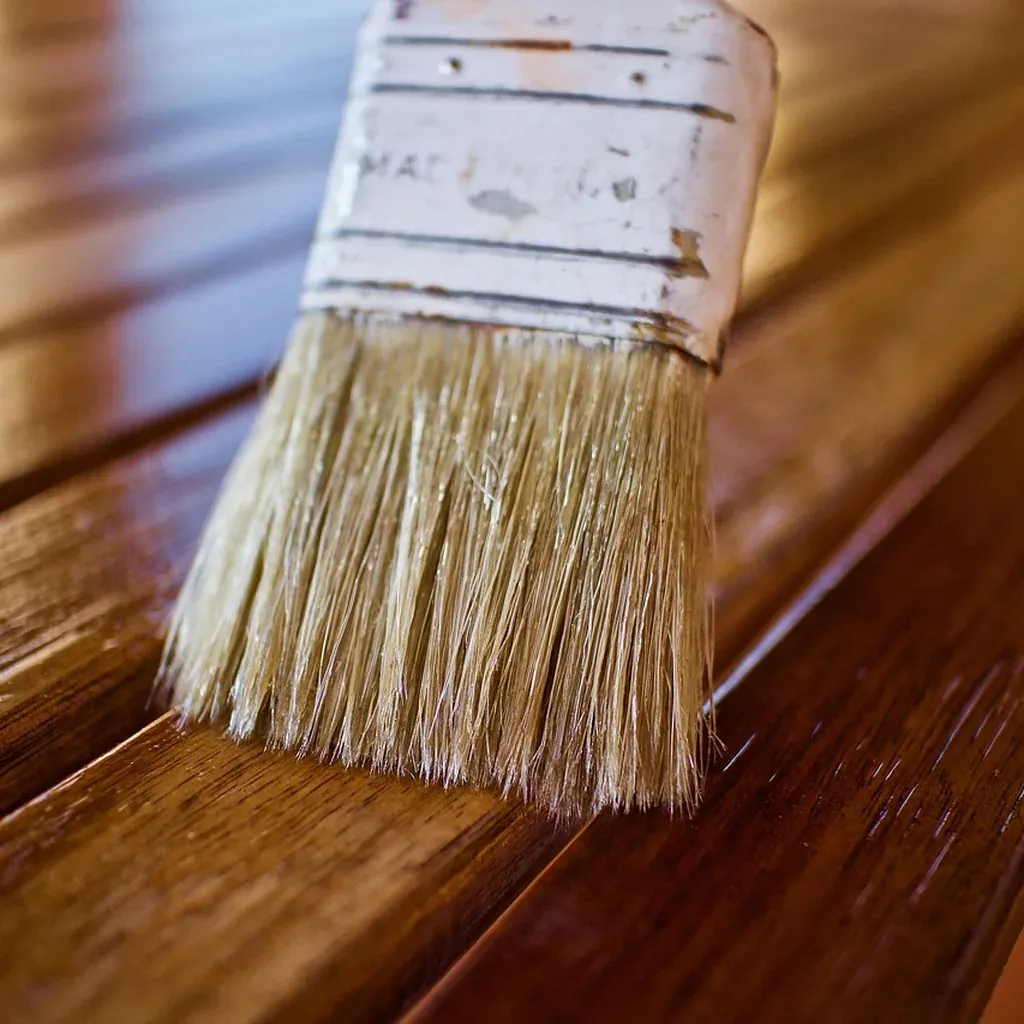
The Handbook's finishing chapter (Chapter 16) explains most of what beginners notice:
- Oak's pores show through film finishes. The chapter says "large pores, especially in clusters such as in the oaks, can leave low spots in the finish where flow deep into the wood structure is easy, requiring filler to get a smooth finish." It also calls red oak "more challenging" to finish than white spruce, "because it is typically twice the density of white spruce, and the large vessels concentrated in a band make a variable surface." If you like the open-grain look, oak is fine under oil or a few coats of a wiping finish; if you want a glass-smooth painted or lacquered surface, plan on grain filler.
- Pine's knots and pitch fight paint. The chapter warns that "many pines contain pitch, which must be hardened or set" and that "Knots of almost all species contain sufficient oils and resins to discolor lightcolored paint." On knotty pine that means a stain-blocking primer over knots before light paint. Between the knots, though, the chapter says white pine, with its thin latewood bands, gives "excellent paint performance," unlike southern yellow pine and Douglas-fir with their wide latewood bands.
- Poplar's even texture paints smoothly. Yellow-poplar is diffuse-porous (Chapter 3), so its pores are small and evenly spread, and as a hardwood it has none of the resin canals the chapter notes are common in spruce, pine, larch and Douglas-fir. That combination gives paint an even surface. Knots still need the same primer treatment.
- Any of the three can stain unevenly. The chapter notes that stains absorb differently into earlywood, latewood, knots and pores, and that blotchiness can come from wood infected by blue-stain fungi or bacteria before drying. Test stain on an offcut first; our guides on staining evenly by hand and fixing blotchy stain cover what to do next.
Which wood for which project
This is our matching, built from the numbers and finishing notes above:
| Project | Best of the three | Why |
|---|---|---|
| Practice cuts and joints | Eastern white pine | Softest, cuts easily by hand, cheap to make mistakes on |
| Painted shelf, cabinet, box or organizer | Yellow-poplar | Even texture, no resin canals, 1.4x harder than white pine |
| Rustic or knotty look, clear finish | Pine | Knots are part of the look; seal knots before light paint |
| Tabletop, stool seat, cutting surface for daily wear | Oak | About 3.4 to 3.6x the dent resistance of white pine |
| Wide panel that must stay flat | White pine, with vertical rings if you can find them | Lowest shrinkage of the four, and very low radial shrinkage |
| Something you will carry up stairs or hang on a wall | Pine or poplar | An oak board weighs nearly twice as much as the same white pine board |
For a first build, a plant stand or floating shelf works well in pine or poplar. If you move up to oak, keep your edges sharp with the beginner sharpening guide; oak's hardness makes a dull tool obvious.
FAQ
Is poplar stronger than pine?
Harder, yes: yellow-poplar's side hardness is 540 lbf against 380 lbf for eastern white pine in the Wood Handbook, so it dents less. Some southern pines are harder than poplar, though, so it depends on which pine.
Is oak worth the extra cost for a beginner?
For parts that take daily wear, such as a tabletop or seat, its hardness (about 3.4 times eastern white pine for red oak) is a real advantage. For painted or decorative pieces, poplar or pine usually does the job for less effort.
Why does my oak finish look rough or pitted?
Oak is ring-porous, with large pores in each growth ring. The Wood Handbook says those pores can leave low spots in film finishes and that filler is needed for a smooth finish.
Can I stain poplar to look like oak?
You can stain poplar, but it will not have oak's open-pore grain pattern, so it will read as a different wood. Test stain on an offcut; uneven absorption is common in many woods.
Which is best for a cutting board?
None of the three is the usual first pick. Our guide to making a wooden cutting board suggests a close-grained hardwood such as maple and a food-safe finish, because the board touches food.