How Much Space Do You Need to Start Woodworking?
The realistic minimum space for a beginner starting woodworking, what a corner, a balcony, or a shared room can actually support, and what can't.

Most beginner woodworking, small hand-tool projects and simple builds with a compact power tool or two, is realistically possible in as little as 25 to 50 square feet: a cleared corner of a room, a section of a balcony, or a folding setup in a spare room. That's enough for a portable work surface, room to swing a handsaw or maneuver a board without hitting furniture, and a place to stand while you work. A dedicated hobby shop, the kind woodworking resources usually describe as a "small shop," is a different question entirely, typically discussed in the 75 to 300 square foot range, and that number is for someone setting up a permanent room, not a beginner testing whether the hobby is worth the space at all.
Two different questions, answered as if they're one
Search this question and most results answer "how big should my dedicated woodshop be," assuming you're planning a garage conversion or a spare room permanently given over to tools. That's a fair question for someone already committed to the hobby, but it isn't the question a beginner in an apartment is actually asking. You're not asking how big a shop should be. You're asking whether you can start at all, in the space you already have, without moving anything permanently. Those are different problems with different answers, and this article is about the second one.
What actually determines the minimum
Square footage alone is a rough proxy. What actually determines whether a space works has less to do with total area and more to do with four specific things:
A stable place to put a workpiece. This can be a portable folding bench, a protected kitchen table, or sawhorses set up temporarily. It doesn't need to be permanent or large, the guide to portable workbenches for small spaces covers what to check on a bench footprint, and cheap workbench alternatives cover options that fit in a closet between uses too.
Clearance to move a tool through its full range of motion. A handsaw needs room for a full stroke without hitting a wall behind you. A circular saw needs a clear path the length of the cut, plus room to stand beside the cut line, not straddling it. This is the number most space guides skip: it's not about the square footage of the room, it's about a specific rectangle of clear floor the length of your longest typical cut, plus elbow room on either side.
Somewhere to store tools and lumber between sessions. A working space that has to be fully cleared and reassembled every single time you build is a real barrier to actually building. The guide to small-apartment tool and wood storage covers this specifically, since storage space and working space are two separate line items that both need an answer, not one.
Overhead and lateral clearance for the tool itself. A hand plane needs a few extra inches of push-through room past the end of the board. A jigsaw or router needs clearance underneath if the workpiece is raised on blocks. These are small numbers individually, but they're the difference between a setup that works and one where you keep clipping a wall or a shelf mid-cut.
What fits in roughly 25 to 50 square feet
That range covers most of what a beginner needs for the first several projects on this site: a coaster set, a small plant stand, a picture frame, or a simple wooden box. It's enough for a folded portable bench opened up, a single sheet of plywood laid flat with room to walk around one side, and enough floor clearance for hand-tool work. It is not enough to permanently store a table saw, rip full sheets of plywood without moving furniture first, or run two people working simultaneously.
What a small dedicated shop range (75 to 300 sq ft) actually buys you
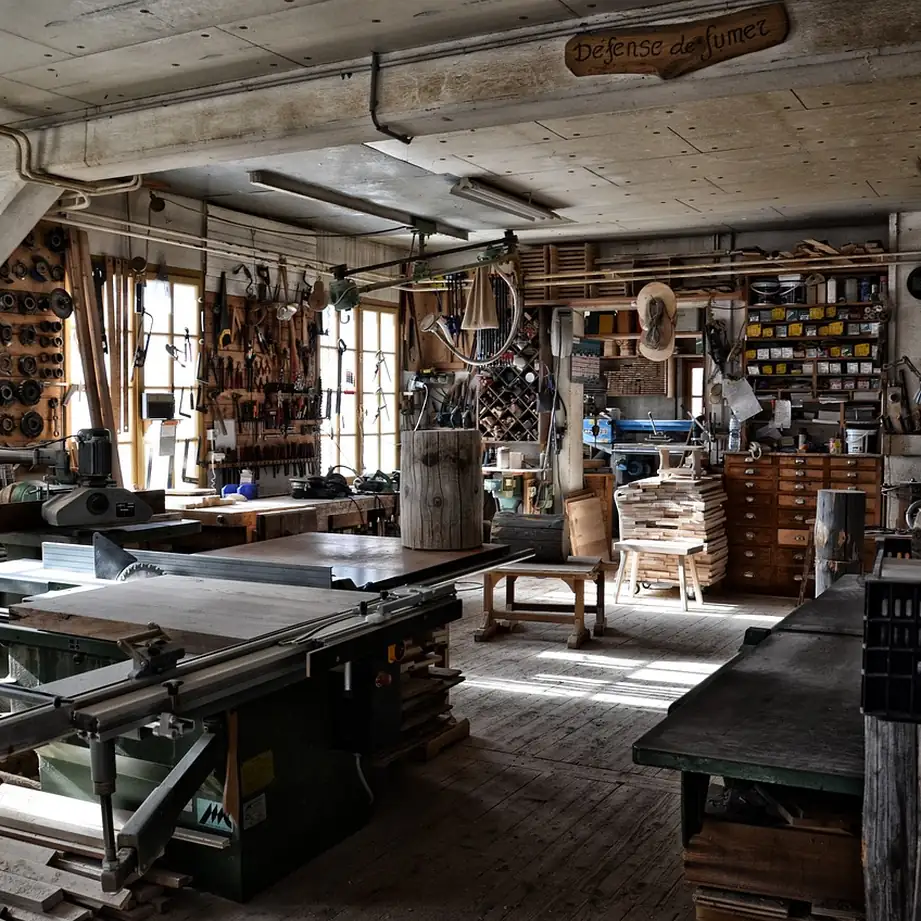
If you eventually move toward a spare room or a section of a garage given over full-time to the hobby, the wider range commonly cited for a small hobby shop reflects real gains: permanent tool placement instead of setup-and-teardown every session, room for stationary equipment like a compact table saw or a drill press, and enough clearance to work on larger furniture pieces without constantly repositioning. None of that is required to start. It's the upgrade path once the hobby has already proven it's sticking, not a precondition for your first project.
The overlooked cost of no dedicated space: setup and teardown time
Here's what most space-requirement guides don't quantify, because it isn't a square-footage number at all: if your working space has to be assembled and broken down every time, that overhead eats into actual building time, and it's the real reason many beginners in shared or rented spaces quit before their first project is even finished. A folding bench that takes two minutes to set up and two minutes to fold away keeps that cost low. A setup that requires moving furniture, laying tarps, and hauling tools out of a closet each time adds real friction that has nothing to do with skill or space size, and it's worth weighing when choosing gear, not just floor area.
A realistic starting checklist by space type
- A cleared apartment corner (roughly 4 by 6 feet of floor): enough for a folding bench, hand tools, and small builds. The temporary workshop setup guide walks through this exact scenario in detail.
- A balcony: works for many projects, with real constraints around weather, dust falling to units below, and lease terms. The balcony-specific project guide covers what's realistic there.
- A shared spare room: the most flexible option if available, since it can hold a folding bench semi-permanently between uses without full teardown.
- A kitchen table, protected and temporary: the lowest-commitment starting point of all, covered in the guide to cutting wood on a table without damaging it.
FAQ
Can I start woodworking with no dedicated room at all? Yes. A cleared corner, a balcony, or a protected kitchen table is enough for most beginner projects. The roadmap for starting without a garage is built specifically around this constraint.
How much floor space does a workbench setup actually need? Plan for roughly 4 by 6 feet of clear floor for a folding bench plus room to move around it, though this varies by project size. The portable workbench buying guide linked above covers footprint specifics for different bench types.
Is a balcony big enough for woodworking projects? Often yes for small builds, but weather, dust falling on neighbors below, and lease terms are real constraints beyond raw square footage. See the balcony projects guide linked above for the specifics.
Do I need more space once I own power tools? Some, mainly clearance for the tool's cutting path and cord management, but a compact circular saw or jigsaw doesn't require dramatically more space than hand tools. A stationary table saw is the real space threshold, and most beginners in small spaces skip it entirely in favor of a circular saw with a guide.
How do I know if my space is too small to start? If you can't lay a full sheet of your typical material flat with room to walk around at least one side, or you can't complete a full saw stroke without hitting something, the space needs adjusting before you start, not abandoning. Often the fix is a smaller first project rather than a bigger room.