How to Pick Lumber That Won't Warp (Beginner Guide)
A board sold as dry can hold up to 19% moisture; indoor furniture wood sits near 8%. How to read the stamp, end grain and board shape before you buy.

Short answer: most boards that warp after you get them home were not bent in the store. They were wetter than your apartment. A softwood board can be sold as "dry" at up to 19% moisture, while the US Forest Service's Wood Handbook recommends about 8% for indoor furniture. So here is how to pick lumber that won't warp: buy the driest stock you can find (look for a KD 15 stamp, or hardwood dried for furniture), choose boards whose end grain shows rings running up and down rather than flat, skip boards with the tree's center in them, and let the wood settle in the room where it will live before you cut it.
The rest of this guide shows how big that moisture gap is in real inches, using the Handbook's own shrinkage tables, and turns it into checks you can do in the aisle in a couple of minutes per board.
Why does lumber warp after you bring it home?
Wood shrinks as it dries, and it does not shrink evenly. The Wood Handbook, Chapter 4 (USDA Forest Products Laboratory, 2021 edition) puts the core fact in one line: "Tangential shrinkage is about twice as great as radial." Tangential means along the growth rings; radial means across them. When one direction shrinks about twice as much as the other, a board with curved rings pulls itself out of shape.
Chapter 13 of the same handbook says warp has two root causes, uneven shrinkage between those directions and stresses left from the tree's growth, and that it gets worse in irregular grain, in juvenile wood near the center of the tree and in reaction wood. It lists "The six major types of warp are bow, crook, twist, oval, diamond, and cup".
The part most beginner guides skip is how much drying is still ahead of a typical store board:
| What the Wood Handbook says | Moisture content |
|---|---|
| Definition of "dry" softwood boards and dimension lumber (Chapter 6) | 19% maximum |
| Framing lumber drying target (Chapter 13) | about 15% average, not over 19% |
| Lumber grade-marked KD 15 (Chapter 13) | generally 15% maximum |
| Recommended for interior furniture and woodwork, most of the US (Table 13-2) | 8% average, 6 to 10% for individual pieces |
| Recommended in the dry Southwest / damp, warm coastal areas (Table 13-2) | 6% average / 11% average |
| Hardwood lumber for furniture and cabinets (Chapter 13) | usually dried to 6 to 8% |
In the Handbook's words, "The definition of dry boards and dimension is lumber that has been seasoned or dried to a maximum moisture content of 19%." It also says common grades of softwood boards and dimension lumber are not normally dried to the indoor values in Table 13-2, and that "Framing lumber, even thoroughly dried stock, will generally have a moisture content greater than that recommended when it is finally delivered to the building site."
That is the gap. A stamp that says "dry" is a promise about 19%, not about your living room.
How much will a board actually shrink in your apartment?
We ran the Handbook's own equations on the dry dressed sizes it lists for boards (a 1x6 is 5-1/2 inches wide, a 1x12 is 11-1/4 inches). The question: if a flatsawn board goes from 19% (the "dry" limit) down to 8% (the indoor furniture target), how much narrower does it get? We used Equation 13-4 with the green-to-ovendry shrinkage values in Table 4-3. These are our calculations from the Handbook's numbers, not measurements of real boards.
| Species (softwoods sold under US grading rules) | 1x6, flat rings | 1x6, vertical rings | 1x12, flat rings |
|---|---|---|---|
| Douglas-fir (Coast) | 0.16 in (4.0 mm) | 0.10 in (2.5 mm) | 0.32 in (8.2 mm) |
| Loblolly pine (a Southern pine) | 0.15 in (3.9 mm) | 0.10 in (2.5 mm) | 0.31 in (8.0 mm) |
| Engelmann spruce | 0.15 in (3.7 mm) | 0.08 in (2.0 mm) | 0.30 in (7.6 mm) |
| White fir | 0.15 in (3.7 mm) | 0.07 in (1.7 mm) | 0.30 in (7.5 mm) |
| Ponderosa pine | 0.13 in (3.2 mm) | 0.08 in (2.0 mm) | 0.26 in (6.6 mm) |
| Eastern white pine | 0.13 in (3.2 mm) | 0.04 in (1.1 mm) | 0.26 in (6.5 mm) |
Three things fall out of that table that change how you shop:
- Width matters as much as species. The 1x12 moves twice as much as the 1x6 because shrinkage scales with width. A wide flatsawn board is the one most likely to cup.
- Ring direction matters more than most beginners think. For every species above, a board with rings running up and down (quartersawn, also called vertical grain or edge grain) shrinks less across its width than a board with flat rings. Eastern white pine is the extreme case: its tangential shrinkage is about 2.9 times its radial shrinkage in Table 4-3, so ring direction decides almost everything for that species.
- A 4 mm shrink is not a 4 mm problem if it is even. It becomes a problem when one face shrinks more than the other, which is exactly what flat rings and curved rings produce. That uneven shrink is what you see as a cup.
Treat these numbers as averages. The Handbook says that "accurately predicting the shrinkage of an individual piece of wood is impossible" and gives a coefficient of variation of about 15% for shrinkage. It also notes that real boards are rarely perfectly flatsawn or quartersawn, so the calculation tends to overestimate width shrinkage on real lumber. The point is the size of the gap, not a promise for a single board.
How to pick lumber that won't warp: six checks in the aisle
These checks follow directly from the Handbook's causes of warp. None needs a tool you would not already carry, apart from the optional meter in check six.
1. Read the stamp before you look at the board
Look for the grade stamp on the board. If it says KD 15, the Handbook says the maximum moisture permitted is generally 15%. A plain "dry" or KD mark on boards and dimension lumber means 19% or less. If the store sells appearance boards or hardwood meant for furniture, ask what moisture they are dried to; the Handbook says furniture and cabinet stock is usually dried to 6 to 8%. Wetter stock is not useless, but it has more shrinking left to do in your home.
2. Look at the end grain
Turn the board and look at the end. If the growth rings run roughly up and down across the thickness, the board is close to quartersawn and will move least across its width. If the rings form a shallow arch across the width, it is flatsawn and is the type that tends to cup. Chapter 3 of the Handbook counts rings at 45 to 90 degrees to the wide face as quartersawn and 0 to 45 degrees as plainsawn. Its table of advantages says quartersawn lumber "Shrinks and swells less in width" and "Cups, surface-checks, and splits less in seasoning and in use".
3. Skip the center of the tree
If the end of the board shows the very center of the rings (the pith), or that center runs along a face, put the board back for any piece that needs to stay flat. The Handbook names juvenile wood from near the center of the tree and reaction wood as abnormal wood that aggravates warp. It says reaction wood, and juvenile wood in some species, can shrink excessively along the length, and that this can cause serious warping such as bow, crook or twist.
4. Sight down all four sides
Hold one end at eye level and look along the length, then rotate the board a quarter turn at a time. You are looking for the four shapes you can see in a store: bow (curve along the wide face), crook (curve along the edge), twist (the ends do not lie in the same plane) and cup (curve across the width). A board that is already moving in the store has started the process you are trying to avoid.
5. Prefer narrow boards for wide parts
Because a 1x12 moves about twice what a 1x6 moves, two straight narrow boards are often a safer buy for a shelf or tabletop than one wide board, especially in flatsawn pine or fir. This is a judgment from the shrinkage math above, not a rule from the Handbook.
6. If you own a moisture meter, take it
The Handbook says pin-type (resistance) meters read reliably from about 6% to 30%, and pinless (dielectric) meters from about 4% to 30%, with readings above 30% only qualitative. It also says to follow the meter maker's species and temperature corrections. A board reading in the high teens has most of the shrinking in the table above still ahead of it.
What to do with the boards once they are home
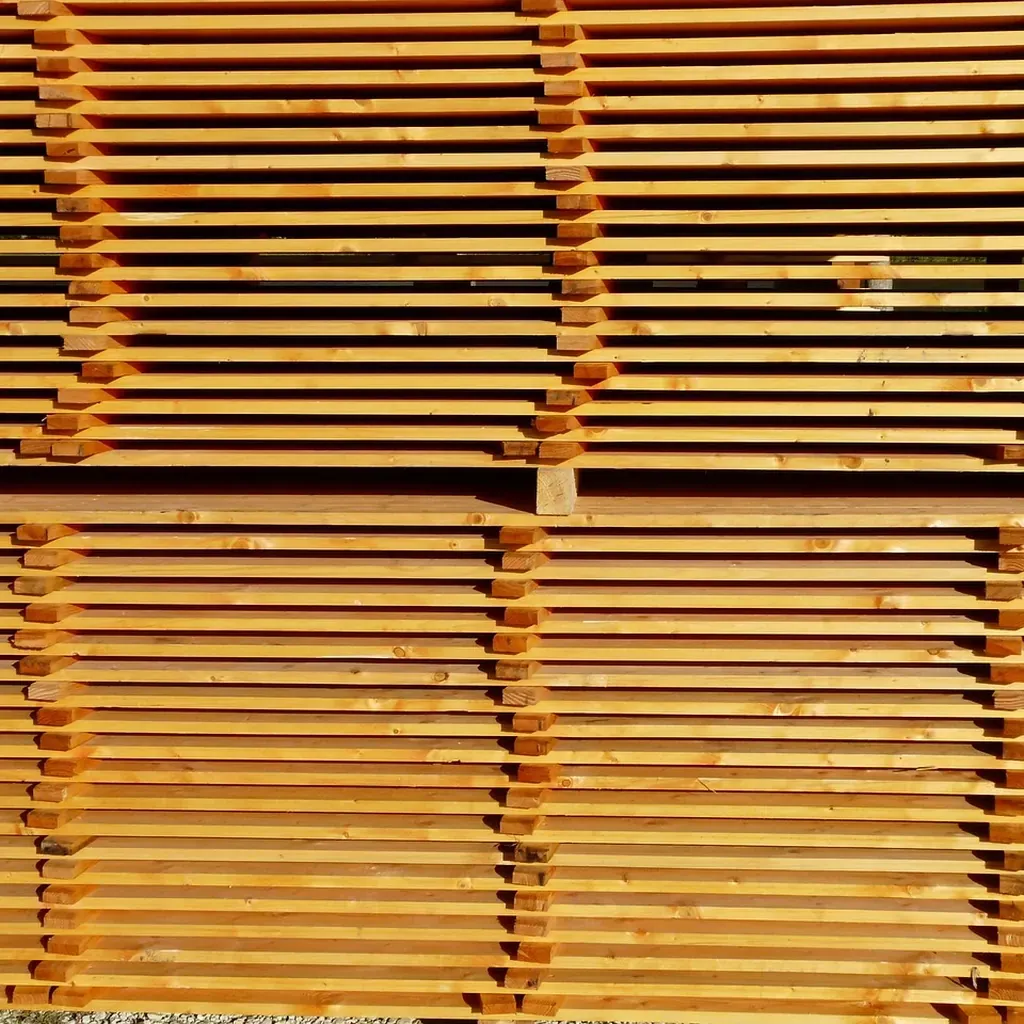
The Handbook's storage advice for this kind of stock is direct: "lumber for processing into furniture should be stored in a room or closed shed where relative humidity is controlled." In an apartment, that means the room where the finished piece will live, not a damp balcony or a closet against an outside wall.
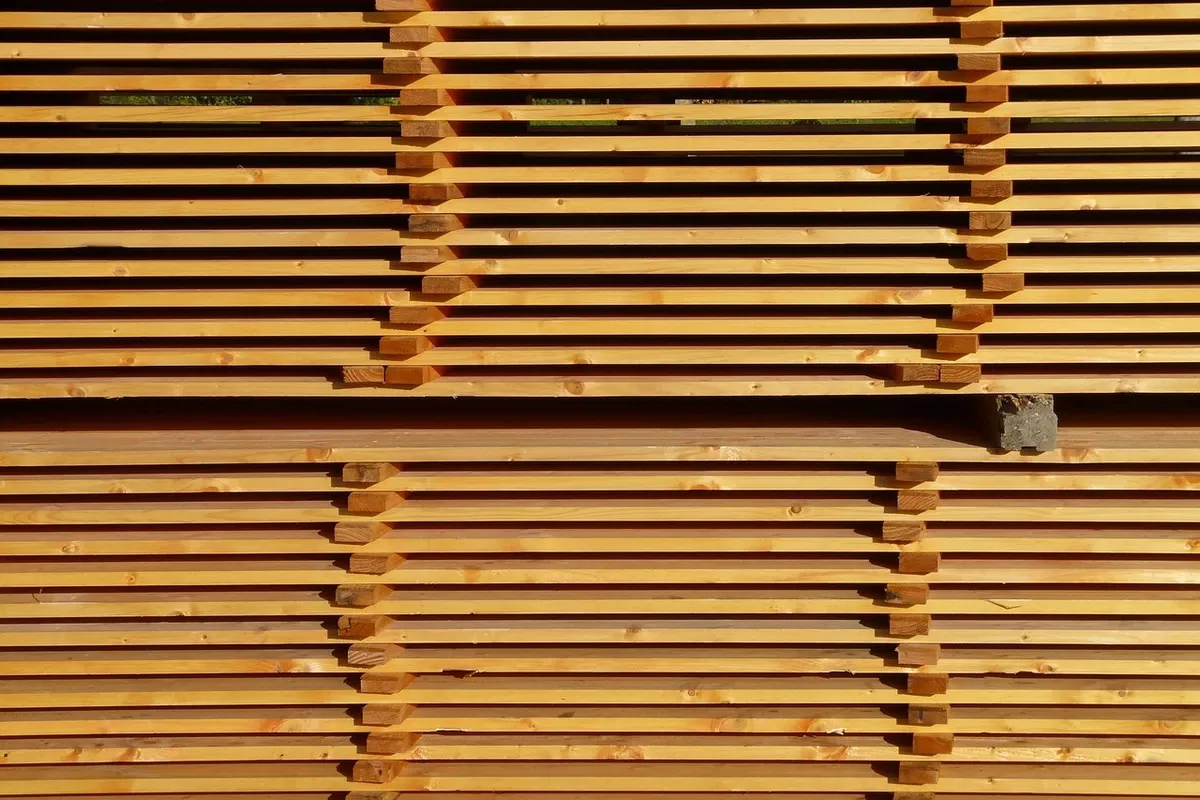
- Lay boards flat with air on both faces. Stack them on a few evenly spaced scrap strips so both sides can dry at the same rate. One face drying faster than the other is the cup you are trying to avoid. Our guide to storing wood and tools in a small apartment covers where that stack can go when space is tight.
- Check whether the wood has stopped drying. Moisture content is defined by weight, so a board that is still drying is still getting lighter. A kitchen or luggage scale gives you a simple home check: weigh the same board every few days, and once the weight stops dropping, it has settled to your room. A meter reading near the Handbook's 6 to 10% range for indoor pieces tells you the same thing faster.
- Cut and plane after it settles, not before. Shrinkage after you cut joints is what opens gaps and pulls a glued panel out of flat.
If you are buying for a specific build, our beginner checklist lists what to bring home besides the boards, and the bookshelf for a small space is a good first project to buy for, since its shelves are exactly the wide flat parts where cupping shows. Accurate cuts start with the measuring and marking habits that keep a slightly moving board from turning into a visibly bad joint.
Does the type of wood matter?
Yes, but less than moisture and ring direction for most beginner projects. Among the species in the table above, the flatsawn 1x6 numbers sit within about 0.03 inch of each other. Ring direction changes the result by more than species does: a flatsawn white pine board shrinks about three times as much across its width as a vertical-ring one.
For a seasonal view, we also ran the Handbook's dimensional change coefficients (Table 13-5) for a 5-1/2 inch flatsawn board drifting across the full 6 to 10% indoor range. That swing came out between about 0.05 inch (eastern white pine) and 0.08 inch (sugar maple) for the species we checked. That is why a board that has already settled to your room still moves a little through the year, and why tabletops are fastened in ways that let them move.
FAQ
Is kiln-dried lumber guaranteed not to warp?
No. Kiln-dried softwood dimension lumber generally averages 19% moisture or less, according to the Wood Handbook, which is still well above the 8% it recommends for indoor furniture. Kiln drying removes much of the water, but the board can keep drying and moving in a heated apartment.
What does KD 15 mean on a lumber stamp?
The Wood Handbook says that to be grade-marked KD 15, the maximum moisture content permitted is generally 15%. Plain "dry" on softwood boards and dimension lumber means 19% or less.
Which way should the growth rings run to avoid cupping?
Up and down through the thickness, as close to vertical as you can find. Those boards are quartersawn or vertical grain, and in every species we calculated they shrink less across their width than flatsawn boards.
Should I let lumber sit before using it?
Yes, in the room where the finished piece will live, stacked flat with air on both faces. Instead of guessing a number of days, weigh a board every few days or use a meter; once the weight stops dropping, or the reading sits near 6 to 10%, it has settled.
Can I fix a board that already warped?
Sometimes, by cutting it into shorter or narrower pieces, or by planing a small cup flat on thicker stock. It is far easier to leave a moving board on the rack than to fix it at home.