Woodworking Tools You Don't Need as a Beginner
The woodworking tools you don't need as a beginner, scored on noise, dust and storage, plus what to do instead and when each stops being a skip.

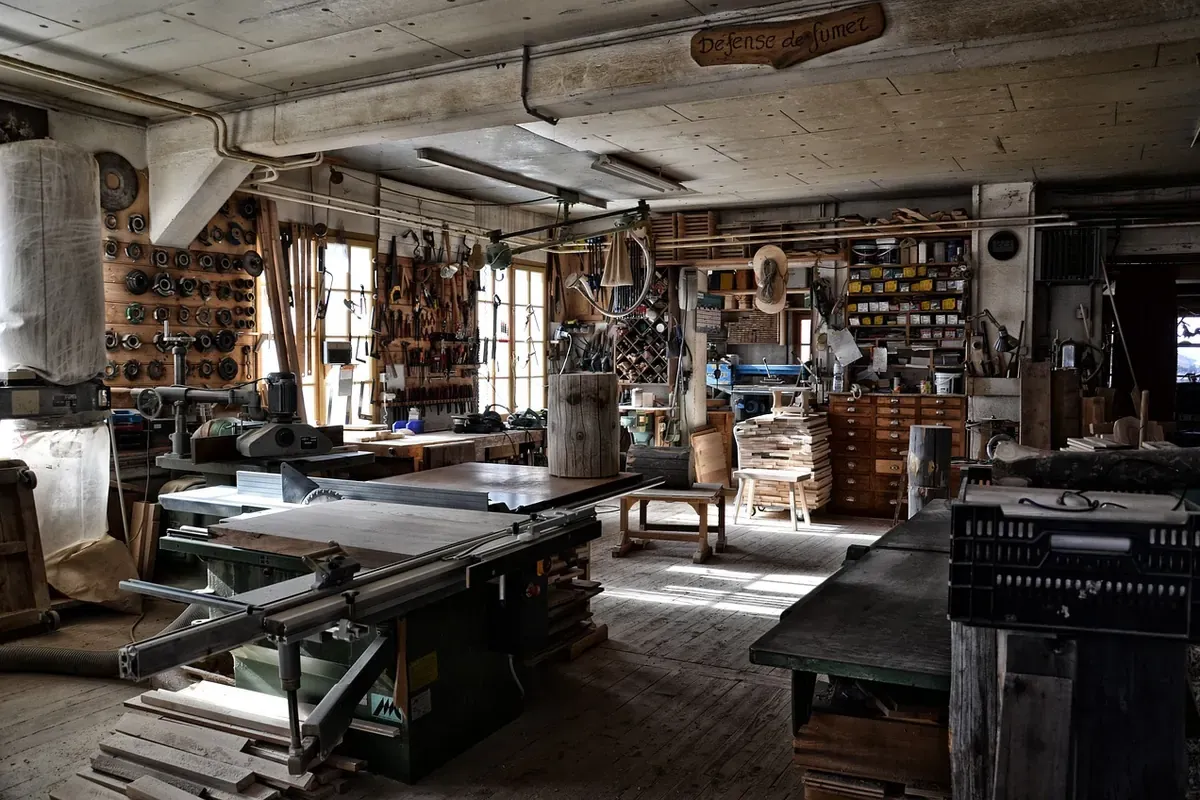
The woodworking tools you don't need as a beginner are the stationary machines: the table saw, the miter saw, the jointer, the thickness planer, the drill press, the bandsaw, the router table, and the joinery gadgets that solve a problem you have not had yet. You also do not need a dedicated workbench. If you have no garage, a drill, a hand saw or a circular saw, a straight edge and four clamps will build almost every beginner project. The machines are not bad tools. They are the wrong first purchase for a room you also sleep in.
Almost every "tools to avoid" list on this topic was written by somebody standing in a garage. That matters more than it sounds, because a garage owner judges a tool on two things: does it do the job, and what does it cost. In an apartment, a spare room or a corner of a shared space, a tool has to pass two more tests before either of those matters, and those two are what change the answer.
The four-part test a tool has to pass in a small space
Run every purchase through all four before the money moves.
- Project count. How many of your next five projects genuinely need it? Not "would be nicer with", need. If the honest answer is one, that is a rental, a borrow, or a workaround, not a purchase.
- Idle footprint. A tool is in use for minutes and stored for months. The real question is where it lives on a Tuesday when you are not building. A machine that has no permanent home ends up on the floor, and a tool on the floor stops getting used.
- Noise floor. Not just how loud, but how loud relative to the wall you share. Universal-motor machines like miter saws and benchtop table saws are among the loudest things in the whole hobby, which is why they are the tools most likely to end a hobby in a rental. We break this down tool by tool in our guide to how loud woodworking tools actually are.
- Dust. Wood dust is classified by the International Agency for Research on Cancer as a Group 1 human carcinogen, and fine dust from sanding and machining is the fraction that stays airborne longest in a room with no ventilation. A machine that throws dust into a space you sleep in is a different proposition than the same machine in an open garage.
A tool that fails two of the four is a skip, no matter how often you have seen it recommended.
The woodworking tools you don't need as a beginner, scored
| Tool | What the shop blogs say | How it scores with no shop | Do this instead |
|---|---|---|---|
| Table saw | The heart of the shop | Fails footprint, noise and dust. Also the highest-consequence tool in the room | Circular saw and a clamped straight edge |
| Miter saw | You need it for crosscuts | Fails noise badly. Throws chips several feet | Hand saw in a miter box, or the circular saw and straight edge |
| Jointer | Flattens rough stock | Fails footprint outright. Solves a problem you can buy your way out of | Buy pre-surfaced (S4S) boards |
| Thickness planer | Brings stock to thickness | Fails noise and dust. Very loud, very high chip volume | Buy stock in the thickness you need |
| Drill press | Precise perpendicular holes | Fails project count for most beginners | A drill and a simple drill guide block |
| Bandsaw | Curves and resawing | Fails project count. Few beginner projects have curves | A coping saw or a jigsaw |
| Router table | Edge profiles and joinery | Fails footprint. Handheld router first, if at all | Skip both until a project demands one |
| Biscuit joiner, domino, doweling jigs | Faster joinery | Fails project count. Glue plus screws or pocket screws does the same job | Glue and screws |
| Benchtop copies of shop machines | Big-tool capability, small price | Underpowered, and they still take the space | Nothing. Save the money |
| Dedicated workbench | Every shop has one | Fails idle footprint hardest of anything on this list | A work-holding setup you can put away |
The table saw: the one worth being blunt about
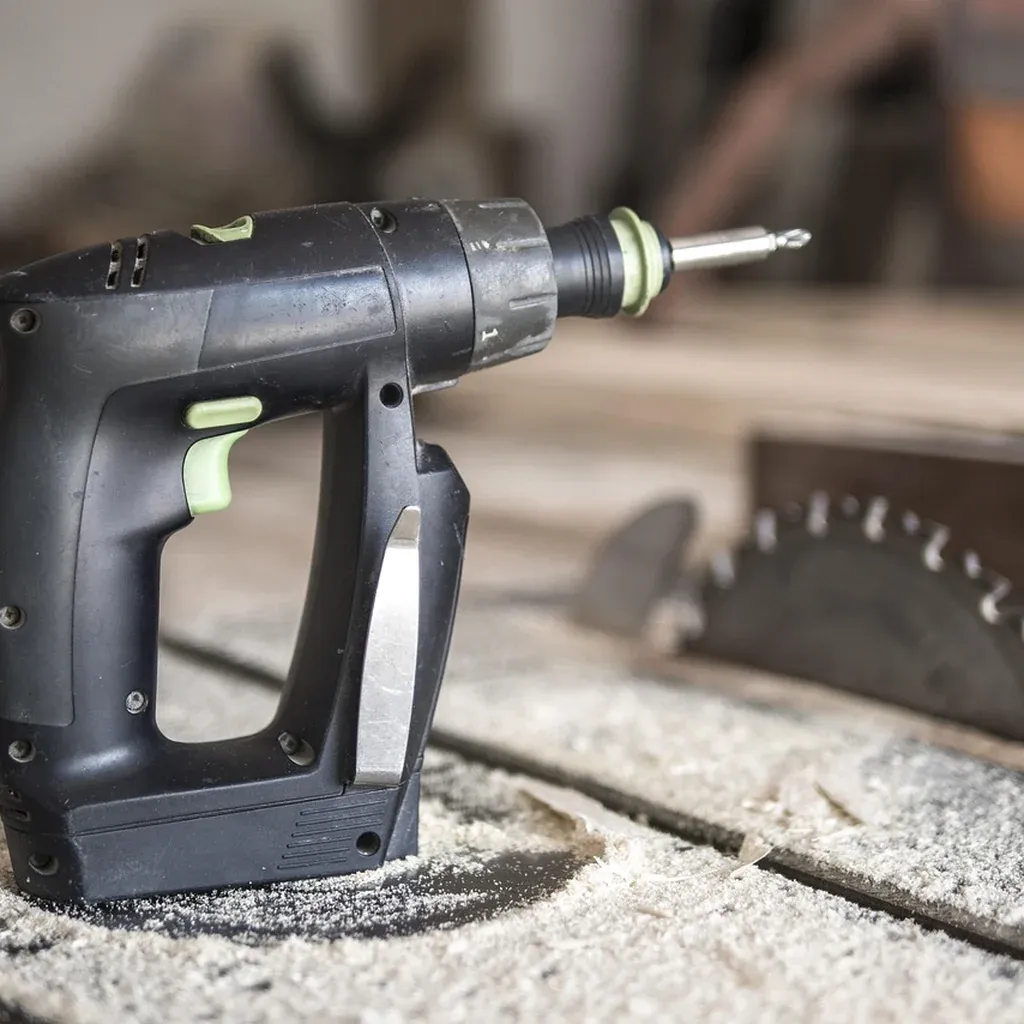
Every beginner tool list treats the table saw as the tool you graduate toward. For a no-shop beginner it is the clearest skip on the list, for three separate reasons.
It is large and it is permanently large. It is loud enough to be a genuine problem through a shared wall. And it is the tool with the worst injury record in the hobby: the US Consumer Product Safety Commission's 2017 Table Saw Blade-Contact Injuries Special Study estimated 26,500 emergency-department-treated blade-contact injuries in that year, of which an estimated 2,800 were amputations. Most of those injuries are fingers.
The mechanism behind a large share of them is kickback: the workpiece binds between the blade and the fence, the rising rear teeth catch it, and the saw throws it back at the operator at speed, often pulling a hand into the blade with it. The riving knife and the blade guard exist to prevent exactly that, and no article on this site will describe removing either one, however routinely you see it done on video. If you ever do own one of these saws, the guard, the riving knife, a push stick, eye protection and hearing protection are the operating condition, not accessories.
A circular saw running against a clamped straight edge makes the same cuts a beginner actually needs, stores flat under a bed, and costs a fraction of the space. It is slower and it needs a setup step per cut. That is the honest trade, and we compare the two properly in circular saw vs table saw for beginners.
Skip the miter saw, the jointer and the planer: the lumber counter does this
These three get grouped because one substitution replaces all of them.
A miter saw is a crosscutting specialist. It is loud, it fires chips across a room, and it needs a stand or a bench to be useful. A hand saw in a miter box crosscuts accurately enough for shelves, frames and boxes, silently, for a small fraction of the space. Our walkthrough of building a picture frame without a miter saw shows what that accuracy actually looks like on a project where the miters are visible.
The jointer and the thickness planer exist to turn rough lumber into flat, square, consistent stock. You can buy that condition instead of making it. Ask for S4S stock, meaning surfaced on four sides, and the mill has already done the jointer and planer's job. Most home centers also stock pre-surfaced boards as standard. Many lumber yards and home centers will also break sheet goods down to your dimensions on their panel saw, usually for a small per-cut fee, which removes the single hardest cut a small-space woodworker faces.
That substitution has a stop condition worth stating plainly: if a project genuinely requires you to flatten rough sawn lumber yourself, the answer is not a benchtop jointer in a bedroom. It is a different board, a hand plane and a lot of practice, or a paid pass at a local mill shop or makerspace.
Skip the drill press, the bandsaw, the router table and the joinery gadgets
These fail on project count rather than on noise or space.
A drill press earns its keep when you drill a lot of perpendicular holes to a repeatable depth. Beginners rarely do. A drill and a simple guide block, a scrap with a square hole in it, gets you close enough for shelf pins and dowels. Drill presses also carry a specific hazard the listicles gloss over: an unclamped workpiece can be caught by the bit and spun, which is why the piece gets clamped and long hair, loose sleeves and gloves stay away from a rotating spindle.
A bandsaw cuts curves and resaws thin stock. Count the curves in your next five projects. If the number is zero, a coping saw or a jigsaw covers you.
A router table is a stationary version of a tool you probably do not own yet. Handheld first, table later, and for most people the honest answer is neither for the first year.
Biscuit joiners, dowel jigs and loose-tenon systems all promise faster, stronger joints. They are genuinely good tools solving a problem a beginner does not have. Glue plus screws, with the screws in a place that will not be seen, is strong enough for a box, a shelf, a stool or a stand. If the joint has to be invisible, pocket screws and plugs get you there without another machine.
Skip the cheap benchtop copies
The most expensive mistake on this list is buying the miniature version of a machine you were going to skip anyway. Underpowered benchtop table saws and mini machines are common beginner purchases because they look like the small-space answer. They usually are not: the motor bogs in real stock, the fence and the table are the parts manufacturers cut cost on, and the accuracy problem you bought the machine to solve comes back. It still occupies the space, and it resells poorly.
There is an exception to the whole "skip the machines" logic and it is worth naming. Buying used or refurbished changes the math on a tool you already decided you need, because the depreciation has already happened. It does not change the math on a tool you did not need.
Skip the dedicated workbench
This is the one that surprises people. A proper bench is the most-recommended first build in the entire hobby, and in a room with no shop it fails the idle footprint test more badly than anything else, because unlike a saw it cannot be put in a closet.
What you actually need is work holding, not a bench: a way to keep a board still while you cut, drill or sand it. Clamps against a sturdy table, a folding portable bench, or a temporary top over an existing surface all do it. We cover the options in cheap workbench alternatives that actually work, and the answer for most readers is a setup that disappears when the session ends.
What the shop-tour skip lists get backwards
Here is where the standard advice inverts for a small space. Two categories that garage lists treat as optional accessories should be near the front of a no-shop budget, and they are cheap.
Dust control comes first, not last. In a garage you open the door. In a bedroom, the dust stays with you. A shop vacuum with a fine-particulate filter attached at the tool, plus a box fan filter and an open window, is not a nice-to-have here, it is the thing that makes the hobby survivable in a shared living space. It also protects your deposit, which is a real consideration in a rental.
Hearing and eye protection are the highest return per dollar in the hobby. NIOSH recommends limiting noise exposure to 85 A-weighted decibels averaged over eight hours, and several common woodworking tools exceed that level the moment they start. Muffs or plugs are a small cost. Safety glasses rated to ANSI Z87.1 are a small cost. Neither is recoverable once the damage is done.
Then clamps. Almost every beginner underbuys clamps and then discovers that a glue-up with two clamps is a glue-up that fails. Clamps are the tool nobody makes a YouTube video about and everybody wishes they had more of.
Then a good straight edge and a square you trust. Accuracy on a circular saw comes from the guide, not the saw. A cheap square that is not actually square will quietly ruin every project you build with it, and it is worth checking any square you own against a known straight edge before you trust it.
That ordering is the whole argument of this site's minimal woodworking tool kit, and it is the reverse of the order a shop tour suggests.
What you actually give up
This would not be an honest article without the concession.
Skipping the machines costs you speed, repeatability and one real capability. Speed, because a straight edge setup takes a minute per cut where a table saw takes seconds. Repeatability, because cutting twenty identical parts by hand is where hand methods genuinely fall down, and a stop block on a miter saw solves that in a way a hand saw does not. And capability: you cannot easily rip a long board to a precise narrow width without a table saw or a track saw, and you cannot flatten rough lumber without a jointer and planer or considerable hand-plane skill.
For a first year of boxes, shelves, frames, stands and small furniture, none of those three losses will stop a project. If your ambitions run to twenty matching drawer fronts or milling your own lumber, they will, and at that point the machines stop being a skip.
When each skipped tool stops being a skip
Buy the tool when a specific, observable thing has happened, not when a video makes you want it.
| Tool | The trigger |
|---|---|
| Table saw or track saw | You have ripped long boards to width with a straight edge and the setup time is now the main thing slowing you down, and you have a place to put it |
| Miter saw | You are cutting repeated identical lengths often enough to want a stop block, and noise is genuinely not an issue where you are |
| Jointer and planer | You want to buy rough lumber for cost or species reasons and have run the numbers |
| Drill press | You have drilled a batch of holes that needed to be perpendicular and repeatable, and hand-drilling failed you |
| Bandsaw | You have a project with curves you cannot cut acceptably with a jigsaw or coping saw |
| Router | A specific project needs a specific profile, joint or template, and you have identified which bit does it |
| Joinery system | You are building something where the fastener genuinely cannot be seen or plugged |
If you want the short version of the whole buying sequence, our beginner woodworking checklist puts the buy-this-not-that decisions in one place.
FAQ
Do I really not need a table saw to start woodworking? No. A circular saw with a clamped straight edge makes the cuts a beginner needs, stores flat, and does not have the table saw's kickback and blade-contact record. The table saw becomes worth it when repeated rip cuts to a precise width become the bottleneck in your projects and you have a permanent place to keep it.
What are the most common tools beginners waste money on? Stationary machines bought before a project needed them, and underpowered benchtop copies of those machines. The pattern is the same in both cases: the purchase was driven by a video rather than by a project sitting on the bench.
Is a cheap mini table saw a reasonable small-space compromise? Usually not. The parts that cost money to make well, the fence, the table flatness and the motor, are the parts that get cut down, so the accuracy problem you bought it to solve comes back. It also still takes floor space and holds its value poorly.
What should I buy first instead of the machines? A drill, a saw appropriate to your noise situation, a straight edge, a square you have checked, more clamps than feels reasonable, hearing and eye protection, and dust control at the tool. That set builds a large share of beginner projects and fits in a closet.
Can I rent or borrow the tools I skip? Often, yes. Tool libraries, makerspaces and rental counters at home centers exist in many cities, and a lumber yard or home center will frequently break down sheet goods for a small per-cut fee. Using someone else's machine for the one cut that needs it is usually a better answer than owning it for the other fifty-one weeks of the year.