Circular Saw vs Table Saw: Which Do You Need First?
The usual answer is cost and portability. The one that matters more is how each saw fails, how it is guarded, and which cut you feed by hand.

For someone with no dedicated shop, the circular saw comes first, and the reason usually given for it is the weakest one. It is not mainly about price or portability. It is that the two saws move the work differently, fail differently and are guarded differently, and one of those differences shows up in injury data.
Both are real tools. Neither is a beginner tool or an advanced tool. What follows is the comparison on the four grounds that actually decide it for a home without a workshop.
The Difference That Explains All the Others
On a circular saw, the tool moves and the wood stays still. On a table saw, the wood moves and the blade stays still. Everything else follows from that one fact.
Because a circular saw travels along the work, it can cut material larger than any bench: a full sheet of plywood lying on foam or across sawhorses, a board still fixed in place, a door on trestles. Its accuracy comes from whatever guides the shoe, which is why a straightedge clamped to the work transforms it.
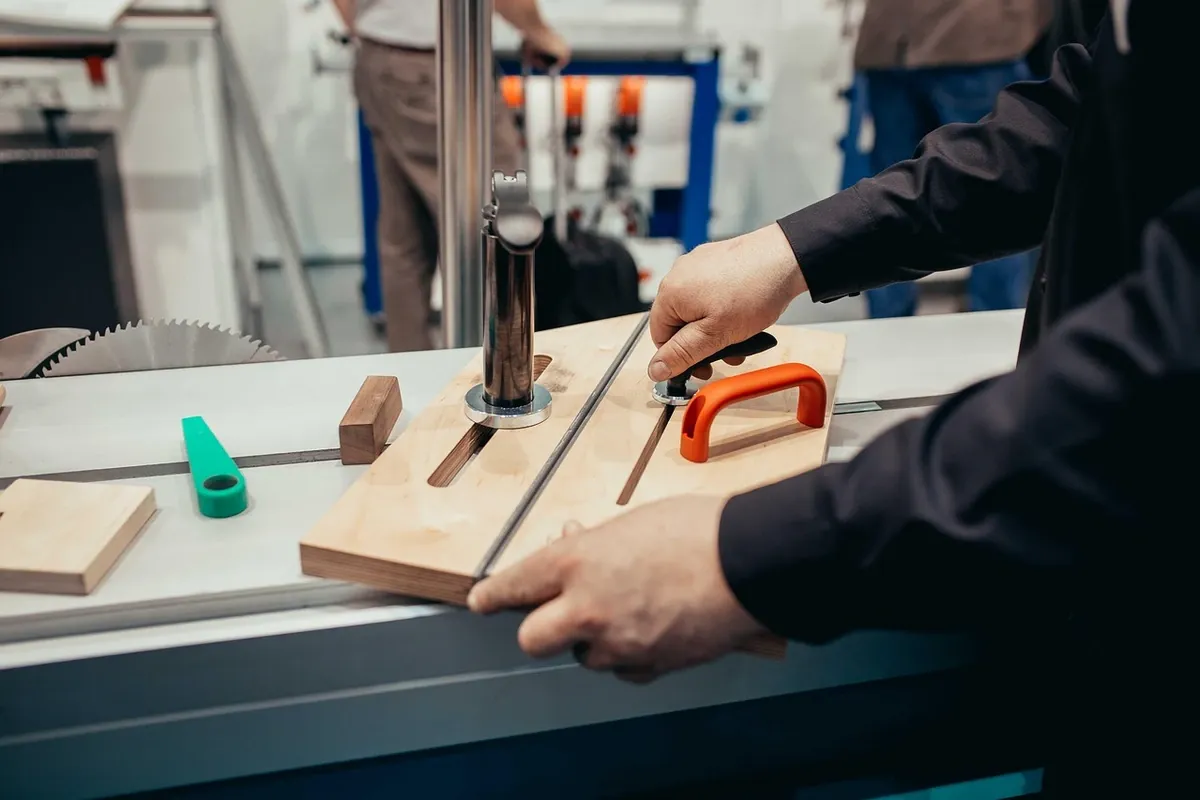
Because a table saw holds the blade still and you push the wood past it, it repeats a cut precisely. A fence set once gives you twenty identical rips. The limit is the size of the table: the work has to be supported and controlled by you across the whole cut, so a full sheet on a small saw is awkward and unsafe rather than merely difficult.
Read that as: the circular saw scales up with the work, the table saw scales up with the repetition. A beginner does far more of the first than the second.
How Each One Hurts You, Which Is Not the Same
This is the part most comparisons skip, and it is the strongest argument in the whole decision.
A table saw's characteristic injury is blade contact with the hand feeding the work. CPSC's special study of 2017 data estimated 26,500 table saw blade-contact injuries treated in US emergency departments. An estimated 25,600 of those, 96.4 percent, involved a finger, with 16,100 lacerations, 5,500 fractures and 2,800 amputations, about 10.7 percent. The mechanism is direct: your hands are what move the wood, and they travel toward the blade every time.
A circular saw's characteristic injury is kickback, where a pinched or bound blade drives the saw back toward the operator, which is a struck-by event that often ends in blade contact as a second step. Kickback is caused by the cut closing on the blade, by an unsupported offcut, or by the blade twisting in the kerf.
Both saws kick back. The difference is what is nearest the blade when it happens. On a table saw the workpiece is launched and your hands are already in the feed path. On a circular saw the tool comes back and your hands are on the handles, behind the blade rather than beside it.
None of this makes a circular saw safe or a table saw dangerous. It makes them different problems to manage, and the circular saw's problem is the one a beginner with no fixed setup can manage better.
Guarding: What Each Tool Gives You Automatically
Guards are the part of this decision you can check before you buy, and the requirements are written down.
For portable circular saws, OSHA 29 CFR 1926.304(d) requires guards above and below the base plate. The upper guard covers the blade to the depth of the teeth except for the arc needed to tilt for bevels. The lower guard adjusts itself to the thickness of the stock and, when the saw is withdrawn from the work, must return automatically and instantly to the covering position. The Power Tool Institute's own circular saw guidance says to check that operation before cutting, never to use a tool with a guard missing, and to repair or adjust a guard that is slow to return or hangs up.
Never tie, wedge or hold that lower guard open. A guard that no longer returns by itself is a defect to be repaired, not a quirk to work around, and the saw does not go back into wood until it is fixed.
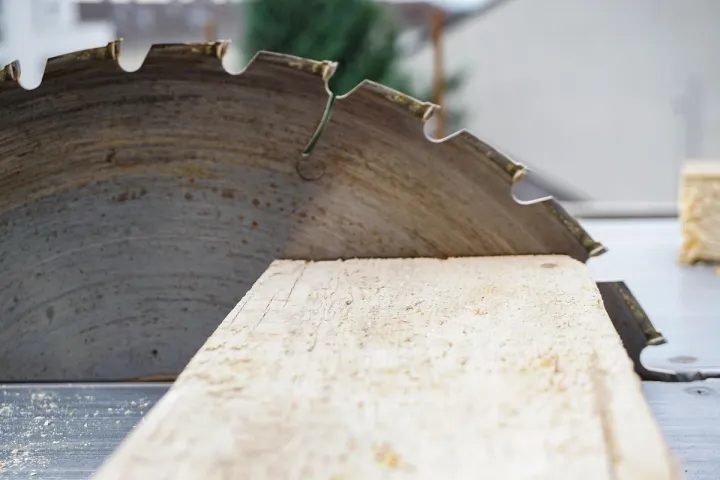
A table saw's protection is a set of separate pieces you have to keep installed: the blade guard, the riving knife or splitter that holds the kerf open behind the blade, and the anti-kickback pawls. The riving knife is the one that addresses the actual kickback mechanism, and it is also the one most commonly removed for a cut and not replaced.
The practical asymmetry: the circular saw's main guard reinstates itself after every cut whether you remember or not. The table saw's protection depends on you putting it back.
Space, Which Decides It Outright for Some Readers
A circular saw goes in a cupboard. A table saw, even a jobsite model, needs a footprint while it is being used that is much larger than the saw itself, because the work has to be supported on both sides of the blade and in front of and behind the fence.
Do not measure a table saw by its own dimensions. Measure the space you need to feed a board through it. For a four-foot rip that is roughly nine feet of clear line, plus somewhere to stand.
There is a second cost that only shows up at home: a table saw is a fixed, heavy, loud machine that transmits into the building it is bolted or standing on, which matters in an apartment for reasons covered in the temporary workshop setup. A circular saw can be used outdoors, on a balcony where permitted, or over a sacrificial sheet on a floor.
If your constraint is space rather than money, this section is the whole answer, and the general approach to it is the subject of woodworking without a garage.
Accuracy: The Gap Is Real, and It Is Closable
The genuine advantage of a table saw is repeatable accuracy. A fence, set once, gives identical parts, and for anything with many matching pieces it is faster and better.
A circular saw freehand is not accurate. A circular saw against a clamped straightedge is much closer than most beginners expect, and that is the piece of the comparison usually left out. What you add to close the gap is a guide, either a shop-made straightedge clamped to the work or a commercial track.
Two honest limits on that. First, a straightedge guide is a setup per cut, so ten identical parts take ten setups where a table saw takes one. Second, narrow rips are where a circular saw is genuinely worse, because there is not enough material left to clamp a guide to safely.
So the accuracy question resolves into: how many identical narrow pieces does your work need? For shelves, boxes, frames and most of the builds in the renter project guide, the answer is few enough that a guide covers it.
The Third Option Worth Naming
Neither saw is compulsory. A large share of small-space projects can be built with a hand saw, and the reason to say so here is that the noise, dust and space problems all disappear at once.
The honest trade is speed. Breaking down a sheet of plywood by hand is slow work. Cutting the six pieces of a small box is not, and the difference between a hand-cut and machine-cut result at beginner level is smaller than the marketing suggests.
If your building, your hours or your budget rule out a powered saw right now, that is not the end of the hobby. The hand-tool path is used throughout this site, including in a picture frame without a miter saw, and it is a legitimate way to build for a year before buying anything with a motor.
So Which One First
Buy the circular saw first if: you have no dedicated space, you work in more than one place, you will cut sheet goods, you want to store the tool out of sight, or noise and setup time are constrained by other people in the building. That covers most readers of this site.
Consider the table saw first only if: you have a permanent space you can leave it set up in, your work is mostly repeated narrow rips in solid stock, and the noise and footprint are genuinely not a problem where you live.
Buy neither yet if: your next three projects are small, in which case a hand saw and the money saved will teach you more about which powered saw you actually want. That is the sequencing argument made in the minimal tool kit.
The Short Version
- Circular saw: tool moves, work stays still. Table saw: work moves, blade stays still. Everything follows from that.
- The injury profiles differ. CPSC estimated 26,500 table saw blade-contact injuries in 2017, 96.4 percent to fingers and about 10.7 percent amputations. The circular saw's characteristic event is kickback of the tool.
- The circular saw's lower guard reinstates itself after every cut, per OSHA 1926.304(d). A table saw's guard and riving knife depend on you replacing them.
- Never wedge, tie or hold a guard open. A guard that does not return is a repair.
- Measure the space a table saw needs to feed a board, not the space the saw occupies.
- A clamped straightedge closes most of the accuracy gap, except on narrow rips.
- A hand saw is a real third answer when space, noise or budget rule out both.
Frequently Asked Questions
Can a circular saw do everything a table saw does? Not equally. It handles crosscuts, sheet breakdown and long rips well with a guide, and it is genuinely worse at repeated narrow rips, because there is not enough width left to clamp a guide safely. That specific cut is the table saw's real advantage.
Is a track saw the compromise? It is the same tool with the guide built in, so it removes the per-cut setup and improves edge quality. It is a more expensive purchase than a circular saw and a guide, and it does not change the space or noise picture.
Is a jobsite table saw small enough for an apartment? The saw is, the operation is not. You still need clear space in front of and behind the blade equal to the length of the cut, plus a stable base, and it is a loud machine transmitting into a shared structure.
Do I need a riving knife? If you use a table saw, yes, use the one it came with. It holds the kerf open behind the blade so the cut cannot close and pinch, which is the kickback mechanism itself.
Which is better for plywood? The circular saw, for a full sheet, by a wide margin. Handling an eight-foot sheet across a small table saw is difficult to do safely, and the sheet is easier to cut where it lies.