How to Tell If Lumber Is Warped Before You Buy
A No. 2 board can pass grade with 3/8 inch of crook. How to tell if lumber is warped in the aisle: four shapes, a coin gauge and a two-minute check.

Short answer: how to tell if lumber is warped comes down to four shapes: bow (curved along the wide face), crook (curved along the edge), twist (corners not in one plane) and cup (curved across the width). Sight down it, then set it on the floor and look for a gap. The catch is that "passes grade" does not mean "straight." Under the 1998 Western Wood Products Association rules that a 2004 US Forest Service study used, an 8-foot No. 2 2x4 could have up to 3/8 inch of crook, 3/4 inch of bow and 1/2 inch of twist and still be a No. 2.
So the check below is not about whether the store should have sold the board. It is about whether the board is straight enough for your project, measured with something you already have in your pocket.
What counts as warped lumber?
Lumber grading rules define each shape precisely, and the definitions double as a measuring method. The National Lumber Grades Authority rules (NLGA, the Canadian rules-writing agency, 2022 edition) say:
- Bow "is a deviation flatwise from a straight line drawn from end to end of a piece." Picture the board lying on its wide face with its middle lifted like a shallow bridge.
- Crook "is a deviation edgewise from a straight line drawn from end to end of a piece." Same curve, but seen on the narrow edge.
- Cup "is a deviation in the face of a piece from a straight line drawn from edge to edge of a piece." The board curves across its width like a shallow gutter.
- Twist is measured as "the distance an edge of a piece at one end is raised above a flat surface against which both edges at the opposite end are resting snugly." Three corners touch the floor; the fourth floats.
For bow, crook and cup, the rules add: "It is measured at the point of greatest distance from the straight line." In practice that is the biggest gap you can find under the middle of the curve.
How much warp can a board have and still pass grade?
More than most beginners expect. A US Forest Service research paper on 2x4s (Simpson, FPL-RP-624) tabulates the warp limits for 8-foot 2x4s under the Western Wood Products Association's 1998 Structural Light Framing rules:
| Grade (8-ft 2x4) | Max crook | Max bow | Max twist |
|---|---|---|---|
| Select Structural | 1/4 in | 1/2 in | 3/8 in |
| No. 1 | 1/4 in | 1/2 in | 3/8 in |
| No. 2 | 3/8 in | 3/4 in | 1/2 in |
| No. 3 | 1/2 in | 1 in | 3/4 in |
Those are 1998 limits from one rules agency, quoted in a 2004 study, so treat them as a sense of scale, not as today's exact numbers for every stamp. The current NLGA grading rules express the same idea through warp classes from "very light" to "heavy." In those tables, an 8-foot piece with a 3 or 4 inch face is allowed 3/8 inch of crook in the "light" class and 1/2 inch in "medium." Even the lightest cup class allows 1/16 inch of cup across an 8-inch face.
A framing grade is written for walls, where a stud gets nailed straight. A bookshelf side or a box lid has nothing pulling it flat. That is why a board can be perfectly legal and still wrong for your project.
How to tell if lumber is warped: a two-minute check in the aisle
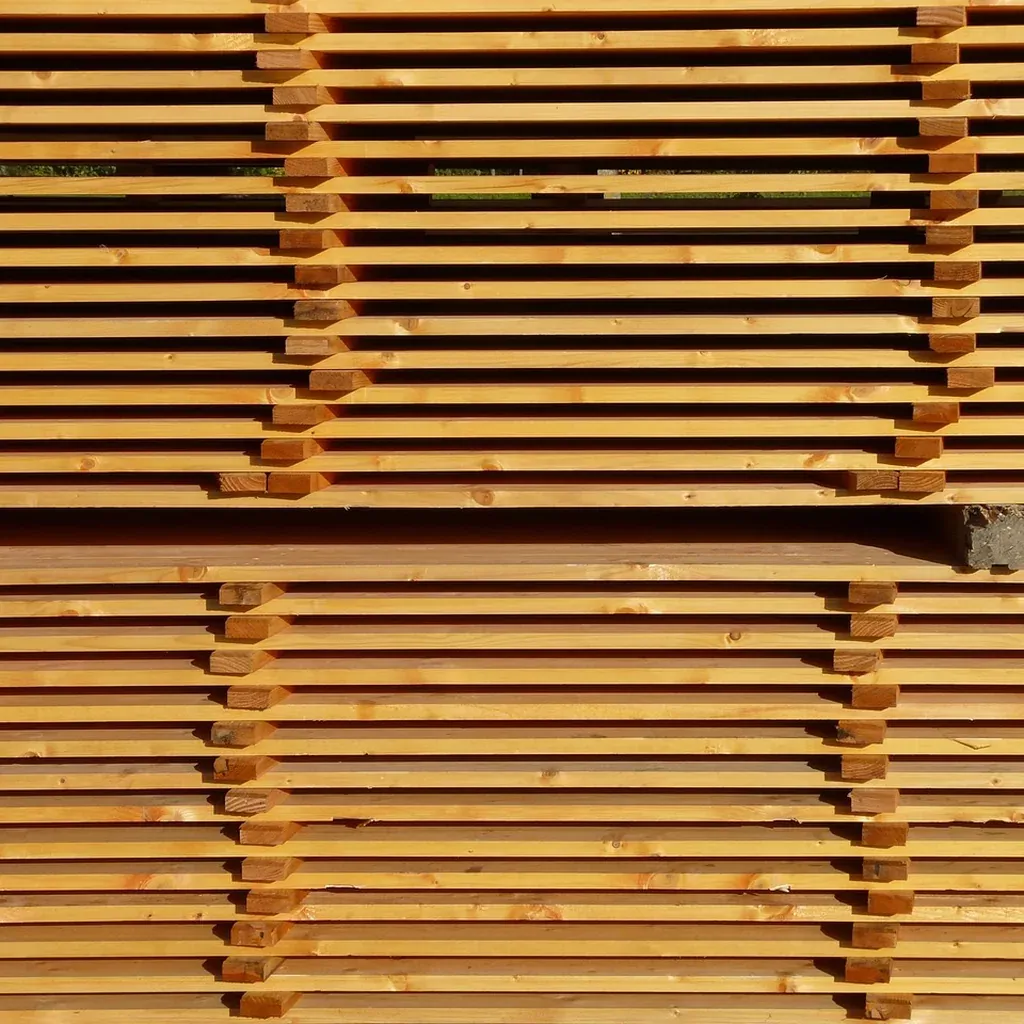
You need a clear patch of floor and a few coins. A US quarter is 0.069 inch (1.75 mm) thick according to the US Mint's coin specifications, so a short stack works as a feeler gauge.
Step 1: Sight down it. Hold one end at eye level, close one eye and look along each edge and each face, turning the board a quarter turn at a time. This catches the obvious rejects in seconds.
Step 2: Check crook on edge. Stand the board on its narrow edge on the floor with the hump up, so both ends touch. Slide coins into the gap at the middle. The highest point of the gap is the crook.
Step 3: Check bow on the face. Lay it on its wide face, hump up, and repeat.
Step 4: Check twist. Lay it flat and press one end down so both of its corners touch the floor. Look at the far end. If one corner lifts, that lift is the twist.
Step 5: Check cup across the face. On wider boards, hold a straight edge (the edge of another board you have already checked, or a level from the tool aisle) across the face and look for daylight under it.
Step 6: Flip it end for end. Store floors are not guaranteed flat. If the gap stays with the board when you turn it around, the board is curved. If it stays with the same spot on the floor, the floor is.
Here is what the coin stacks mean against those 1998 limits for an 8-foot 2x4. These are our conversions using the Mint's thickness figure:
| If this many stacked quarters fit in the gap | The board has more than |
|---|---|
| 4 quarters (0.28 in) | 1/4 in: past the Select Structural and No. 1 crook limit |
| 6 quarters (0.41 in) | 3/8 in: past the No. 2 crook limit |
| 8 quarters (0.55 in) | 1/2 in: past the No. 2 twist limit |
| 11 quarters (0.76 in) | 3/4 in: past the No. 2 bow limit |
For furniture parts you will usually want far less than any of these. If one or two quarters fit, the board is close to straight; if a whole stack fits, it is a framing board, not a shelf.
Keep the straightest boards and move on. If you are measuring at home afterward, our guide to measuring and marking wood accurately covers the tools that make the next steps precise.
Why can a straight board in the store warp at home?
Because it keeps drying. In the Forest Service study above, 8-foot ponderosa pine 2x4s were kiln dried, planed, settled at about 14% moisture, then moved to a room at roughly 4 to 5% equilibrium moisture to simulate dry indoor conditions in the interior West. The paper's summary: "When boards were equilibrated to 4% to 5% moisture content, warp and grade loss from warp increased significantly."
The averages from its Tables 6 and 9 show how much:
| Drying temperature group | Avg. bow at about 14% MC | Avg. bow at 4 to 5% MC | Avg. crook at about 14% MC | Avg. crook at 4 to 5% MC |
|---|---|---|---|---|
| 160°F | 0.385 in | 1.297 in | 0.213 in | 0.581 in |
| 230°F | 0.348 in | 1.053 in | 0.195 in | 0.456 in |
| 280°F | 0.272 in | 0.925 in | 0.187 in | 0.459 in |
Every group's average bow roughly tripled, and the average crook more than doubled, after the extra drying. After drying, every group's average went past the No. 2 limits in the table above (3/4 inch bow, 3/8 inch crook).
Two cautions on reading this. The boards came from small, open-grown ponderosa pine trees about 9 inches in diameter, from a 30- to 35-year-old stand, so they are not a sample of every species or store. And 4 to 5% is drier than the 6 to 10% the US Forest Service Wood Handbook recommends for indoor woodwork in most of the US. Still, the direction is the lesson: a board that has more drying ahead of it can move after you buy it, so checking shape in the store is necessary but not enough. Let boards settle in the room where they will be used, stacked flat with air on both sides, before you cut. Our guide to storing wood in a small apartment shows where that stack can go.
Can you still use a slightly crooked board?
Often, yes, if your parts are short. If a board's crook is a smooth, even curve, the gap over a shorter piece shrinks with the square of its length. By our geometry (a circular arc, which real boards only approximate), an 8-foot board with 3/8 inch of crook gives:
| Piece cut from that board | Approximate crook left in the piece |
|---|---|
| 4 ft | 0.09 in |
| 3 ft | 0.05 in |
| 2 ft | 0.02 in |
That is why a board you would reject for a long shelf can still yield good sides for a small wooden box. It does not work the same way for twist, which runs along the whole length, or for a sharp kink near a knot, which the NLGA rules say is appraised "according to its equivalent effect" rather than as an even curve. A slight cup or bow in a short piece can usually be planed out; our hand plane buying guide explains which plane does that job.
Which boards should you leave on the rack?
- Twisted boards for anything that needs to sit flat. Twist does not get smaller when you cut a board shorter the way an even crook does.
- Boards with the center of the tree in them if they need to stay flat. The Wood Handbook names juvenile wood near the center and reaction wood as types that aggravate warp.
- Boards that feel noticeably heavier than their neighbors. At the same size and species, a noticeably heavier board may be carrying extra water, though density also varies from board to board.
- Any board that fails the flip test in step 6 for a part longer than about 2 feet.
FAQ
What is the difference between bow, crook, cup and twist?
Bow curves along the wide face, crook curves along the narrow edge, cup curves across the width, and twist means one corner lifts when the other three touch a flat surface. Lumber grading rules define all four that way.
Is a little warp normal in new lumber?
Yes. Grading rules allow some warp in every grade; in the 1998 Western Wood Products Association limits quoted by the Forest Service, an 8-foot No. 2 2x4 could have up to 3/8 inch of crook and still pass. Whether that is acceptable depends on your project, not on the stamp.
Can I return warped lumber?
Return policies vary by store, so ask at the register. It is quicker to check each board before you buy it with the two-minute routine above.
Will a warped board straighten out if I store it flat?
Do not count on it. Storing flat with air on both faces helps a board dry evenly so it does not get worse; it does not reliably undo warp that is already there. Shorter parts or planing are the realistic fixes.