Track Saw vs Circular Saw: Which Cuts More Accurately?
Where a track saw's accuracy actually comes from, what a clamped straightedge does and does not fix, and how kickback and guarding differ between them.

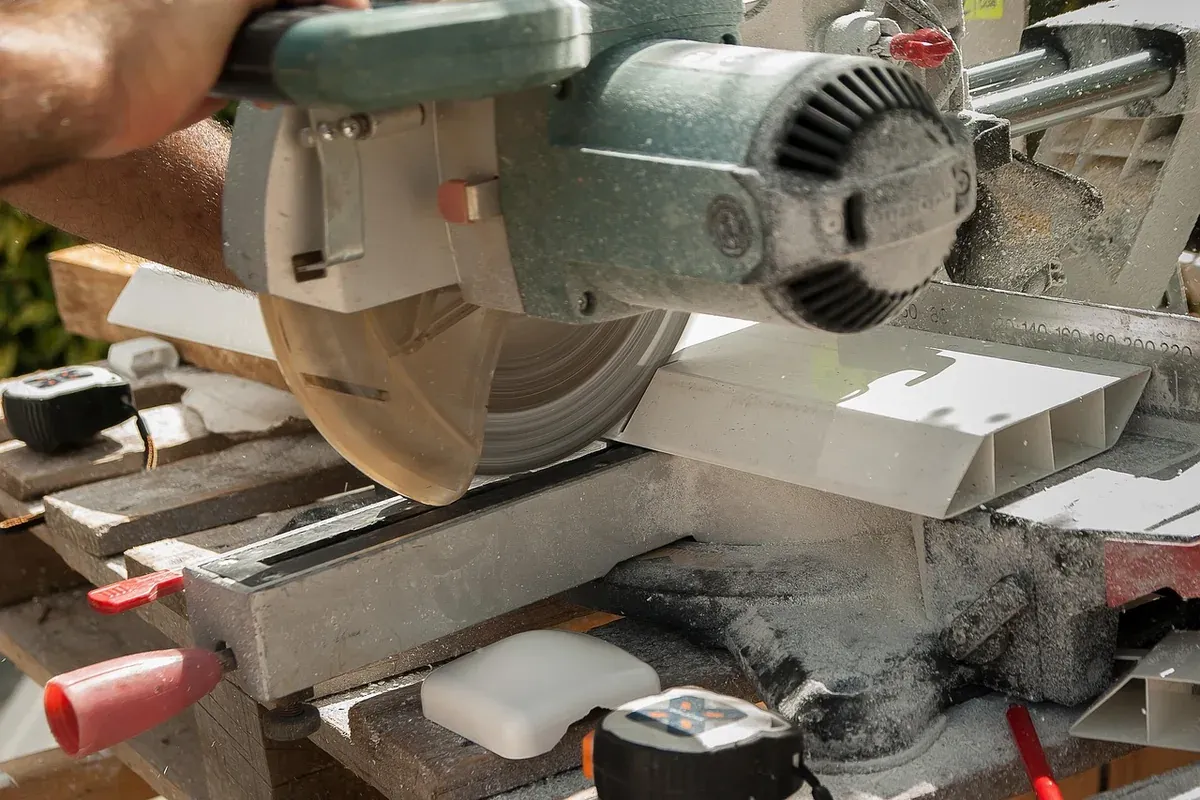
A track saw is more accurate, and the reason is mechanical rather than magical: the saw rides a rail that sits on the workpiece, so the cut line is set before the motor starts. A circular saw references its own baseplate against whatever you have clamped down, which adds two more chances to be wrong. Both are the same class of hazard, and both throw the same kickback.
That accuracy gap is real and it is partly closable. What follows is where it comes from, what a straightedge guide fixes, what it does not, and the safety behavior that does not change between the two.
Where the Accuracy Difference Actually Comes From
A guide rail does three things at once. It gives the saw a straight edge to follow along its whole length, it holds the saw at a fixed angle to the material, and its rubber splinter strip sits right at the cut line so the wood fibers are supported where the teeth exit.
A circular saw against a clamped straightedge gives you the first of those and neither of the others. The saw can still tilt, the baseplate can still lift over a bump, and nothing supports the fibers at the cut edge.
The second difference is where you set the line. With a track saw the rail's edge is the cut line, so you mark two points and lay the rail on them. With a circular saw you have to measure the offset from the blade to the edge of the baseplate and shift the straightedge by that distance, on both ends, every time. That offset is where most beginner cuts go wrong, and it is an arithmetic error rather than a technique error.
| Track saw on a rail | Circular saw with a clamped straightedge | |
|---|---|---|
| Sets the cut line | Rail edge is the line | Measured offset, transferred at both ends |
| Blade angle to the work | Held by the rail and saw base | Held by you |
| Support at the cut edge | Splinter strip on the rail | None |
| Plunge into the middle of a panel | Designed for it | Awkward, guard must be retracted by hand |
| Riving knife | Fitted to some models | Rarely fitted |
| Dust extraction | Enclosed blade, vacuum port | Varies, often a bag or open chute |
| Storage cost | The rail, which does not fold | The saw and a straightedge |
The Four Error Sources a Straightedge Does Not Remove
If you are deciding whether to spend on a rail, these are the failures that stay behind after you clamp a straightedge to a sheet:
Offset error. Measured once, transferred twice, wrong at one end. The cut comes out tapered.
Tilt. The blade is only square to the material if the baseplate is flat on it. Lean the saw slightly and the edge is out of square through the thickness, which shows up when you try to join two of those edges.
Baseplate lift. A thin stamped baseplate can ride up over sawdust, a clamp head or the sheet's own bow.
Exit tear-out. A circular saw's blade rises through the material, so it splinters the top face. There is no splinter strip to support it, and on veneered plywood that is the visible face.
None of these mean a circular saw cannot do the work. They mean the result depends on you every time, rather than on the tool. The wider question of which saw earns its space first is covered in the circular saw and table saw comparison, and this page assumes you have already read that and are choosing between guided options.
Kickback: Identical Physics, Different Protection
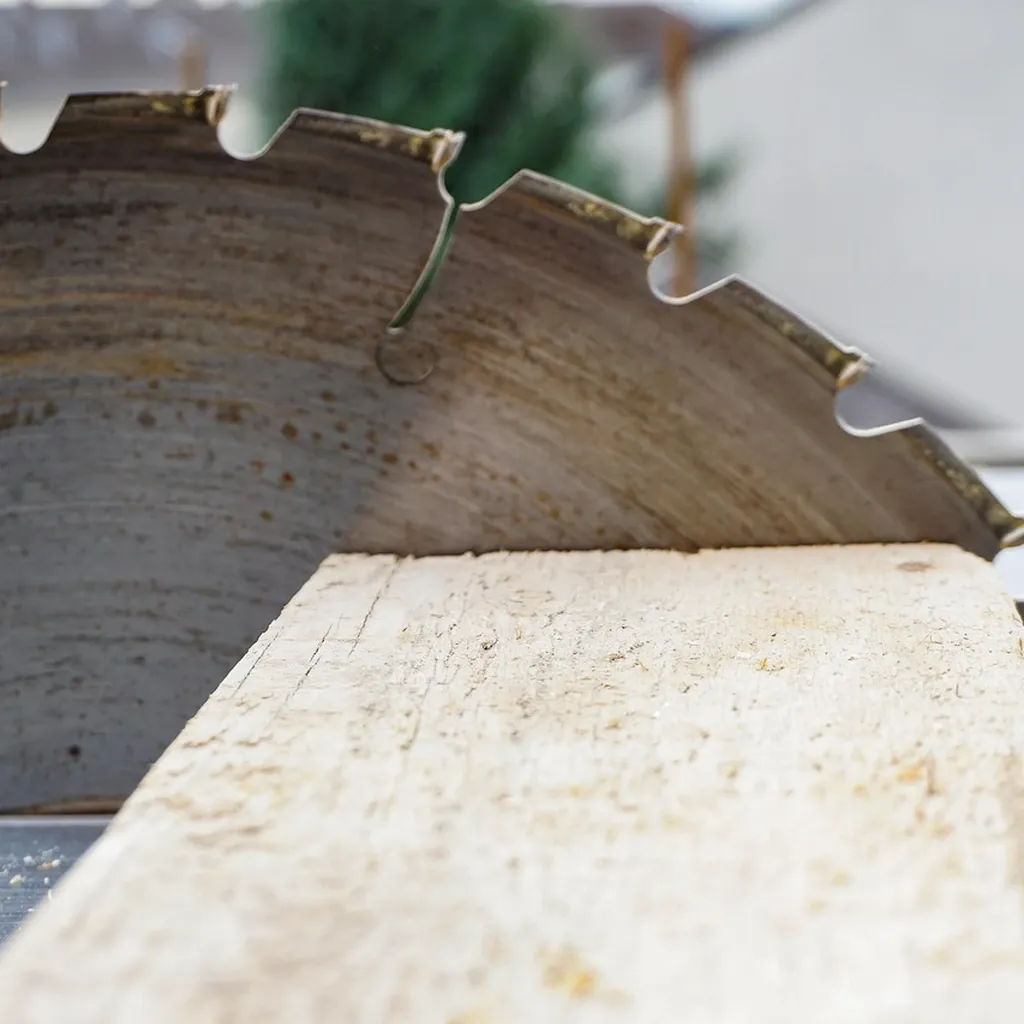
Kickback is what happens when the blade binds in the cut. The wood pinches the spinning blade, the blade cannot move forward, so the saw moves instead, backward along the cut line toward you, at speed.
Both tools do this. A rail does not prevent it. It restrains the direction, which is genuinely useful, but a saw that grabs on a rail can still travel and can still pull off the end.
The causes are the same for both:
- The offcut sags and closes the kerf on the blade, which is the usual failure when a sheet is supported only at its edges.
- The workpiece moves because it was not held.
- The saw twists in the cut, so the blade body binds against the kerf walls.
- The blade is dull or the wrong one, so it needs force to feed and heats up.
The fixes are the same too. Support the whole sheet, not its ends. Rigid foam insulation board laid on the floor with the sheet on top is the standard small-space answer, because the offcut has nowhere to fall and the blade cuts a shallow line into the foam instead of the floor. Set the blade depth so the teeth clear the underside by a small amount, not by several centimeters, so less blade is buried and less can bind. Keep the cord behind you. Let the blade reach full speed before it touches wood, and let it stop before you lift the saw.
Guarding Is the Real Difference in Daily Use
A circular saw has a spring-loaded lower guard that is pushed back by the workpiece as you feed, and it must snap closed by itself the moment the cut ends. Check that it does, every session. It is also the part beginners are most tempted to hold open when starting a bevel cut or a cut on a narrow strip. Never wedge, tie or hold it open. If a cut cannot be made with the guard working, the cut belongs on another machine.
A plunge track saw keeps the blade inside its housing until you plunge it, and the blade returns into the housing when you release. That is the safer arrangement for someone still learning: there is no exposed blade at rest, and no guard to fight when starting a cut in the middle of a sheet.
Some plunge saws add a riving knife, a thin plate that follows the blade and holds the kerf open behind it. Festool fits one to its TS plunge saws. Many circular saws have none. If a model has one, that is a genuine safety feature and worth checking on the maker's specification page rather than assuming.
What Each One Costs You in Space, Noise and Dust

This is where the apartment answer diverges from the workshop answer.
A rail is a long object that must be stored. Cutting the long side of a standard sheet, 2,440 by 1,220 mm, needs a rail longer than the sheet, because the saw has to start on the rail before the blade meets wood and finish past it. That means either a rail well over 2.4 m or two shorter rails joined. A rail does not fold, and there is no good place for it in a one-bedroom flat except along a wall or under a bed. Work out where it lives before you buy, using the same approach as the guide to how much space woodworking actually needs.
Dust extraction is usually better on a track saw, because the blade is enclosed and the port is designed around a vacuum rather than a bag. That difference matters more indoors than any accuracy figure.
Noise is a wash and it is loud either way. NIOSH measurements taken in a woodshop put a table saw and a miter saw at roughly 86 to 94 dBA, and a handheld router at 92 to 94 dBA. A circular saw belongs in that same territory. The exposure arithmetic, and what it means for an afternoon of cutting, is in how loud woodworking tools really are. Hearing protection from the first cut, not the tenth.
Which Cuts Belong Somewhere Else Entirely
Two honest stop conditions, because guided cutting has limits.
Narrow rips. Cutting a thin strip off a board with either saw means the baseplate or rail is riding on very little material, and your hands end up close to the blade path to hold the rail down. That cut belongs on a table saw with a fence and push sticks, or it belongs to a jig that lets the workpiece move instead of the saw.
Small pieces. A piece that cannot be clamped without your hand entering the cut line does not get cut with a handheld saw. Cut the profile on a longer board first, then cut the small part off it.
A full sheet on your own, in a tight room, is the third one. Most home centers and lumber yards will break sheets down on their own panel saw, which removes both the most dangerous cut and the transport problem in one step. That is not a defeat, it is what the service exists for. If the tool list itself is what you are working out, the tools you do not need as a beginner covers what to postpone.
The Short Version
- A track saw's accuracy comes from the rail sitting on the work, the fixed blade angle, and the splinter strip at the cut line.
- A clamped straightedge closes part of the gap and leaves offset error, tilt, baseplate lift and exit tear-out behind.
- Kickback is the same hazard on both. Support the whole sheet, set shallow blade depth, hold the work, use a sharp blade.
- The guard is the daily difference: a retractable lower guard you must never wedge open, against an enclosed plunge housing.
- A rail has to be stored, and a full sheet needs one longer than the sheet.
- Narrow rips, small parts and solo full-sheet cuts belong on another machine or at the yard's panel saw.
Frequently Asked Questions
Is a track saw worth it for someone who has just started? It depends on what you cut. If most of your work is sheet goods for shelving and cabinets, the rail removes the error source that ruins those cuts. If most of your work is solid timber at furniture scale, a circular saw and a good straightedge will not hold you back, and the money is better spent elsewhere.
Can a circular saw be as accurate as a track saw? Close, on a good day, with a rigid clamped guide and careful offset measurement. What it cannot match is repeatability: the rail gives the same result on the twentieth cut as on the first, without measuring an offset again.
Do track saws kick back? Yes. The rail restrains the saw's direction and some makers sell a stop that clamps to the rail, but binding in the kerf still throws the tool. Treat it with the same respect as any circular saw.
Can I use a track saw instead of a table saw? For breaking down sheets, often yes, and in a small home it is the more realistic tool. For narrow rips, repeated identical widths and small parts, no. Those are the operations a fence and a fixed table exist to make safe.
What blade should be in it? A sharp one with a tooth count suited to the material: fewer, larger teeth for ripping solid wood, more teeth for crosscuts and plywood faces. A dull blade is a kickback cause, not just a quality problem, and it is the cheapest fix on this page.