Beginner Woodworking Mistakes, Sorted by What They Cost
Some beginner mistakes cost a board, some cost the project, and three of them cost a finger. Sorted by consequence, with the fix inside each one.

Not all beginner mistakes are the same size, and lists that treat them as one bucket are useless. Some cost you a board. Some cost you the project. Three or four of them cost you a trip to an emergency department, and those are the ones that deserve to be read first.
So this is sorted by consequence rather than by topic. The expensive ones are at the top, the annoying ones below, and every entry says what to do instead rather than only what not to do.
Mistakes That Can Injure You
Defeating a guard, in any way, for any reason
This is first because it is the one that comes with forum advice attached.
OSHA's rule for portable circular saws, 29 CFR 1926.304(d), requires guards above and below the base plate and requires the lower guard to return automatically and instantly to the covering position when the tool is withdrawn from the work. The Power Tool Institute's circular saw guidance is to check guard operation before each use, never to use a tool with a guard missing, and to repair or adjust a guard that is slow to return or hangs up.
What to do instead: if the guard snags on the start of a cut, that is a support and angle problem. Start the cut with the shoe flat on the work, let the blade reach speed before it touches wood, and support the offcut so it cannot pinch. If the guard is genuinely sticking, the tool goes to be fixed, not into the wood. There is no version of tying, wedging or holding a guard open that is a technique.
Holding a small piece by hand while cutting it
Small offcuts are where hands and blades meet. The piece is too short to clamp, the cut takes two seconds, and the hand is right there.
What to do instead: cut the small piece while it is still part of a long board, then separate it. Sequencing the cuts differently removes the situation entirely. If the piece must be cut on its own and cannot be clamped, that is the point to stop and set up proper holding rather than to proceed carefully. The work-holding options that actually work in a home are in woodworking without a workbench.
Underestimating a table saw because it looks stable
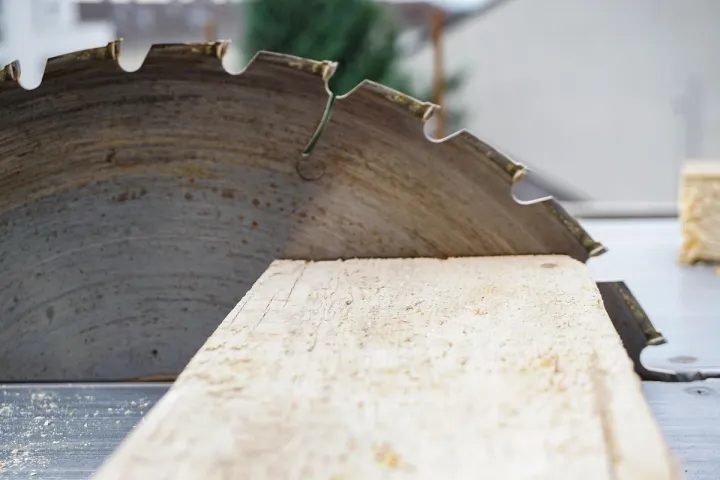
A table saw feels safer than a handheld saw because the blade is fixed and the operator is standing still. The injury data does not agree.
CPSC's special study of 2017 data estimated 26,500 table saw blade-contact injuries treated in US emergency departments, of which an estimated 25,600 involved a finger and about 10.7 percent, roughly 2,800, were amputations.
What to do instead: if you own one, use the riving knife or splitter and the blade guard that came with it, use a push stick for anything narrow, and never reach over or behind a spinning blade to clear an offcut. If you do not own one yet, this is a good reason not to make it your first purchase.
Skipping eye protection for "just one cut"
The cut that gets you is always the quick one, and eye injuries are not proportional to the size of the job.
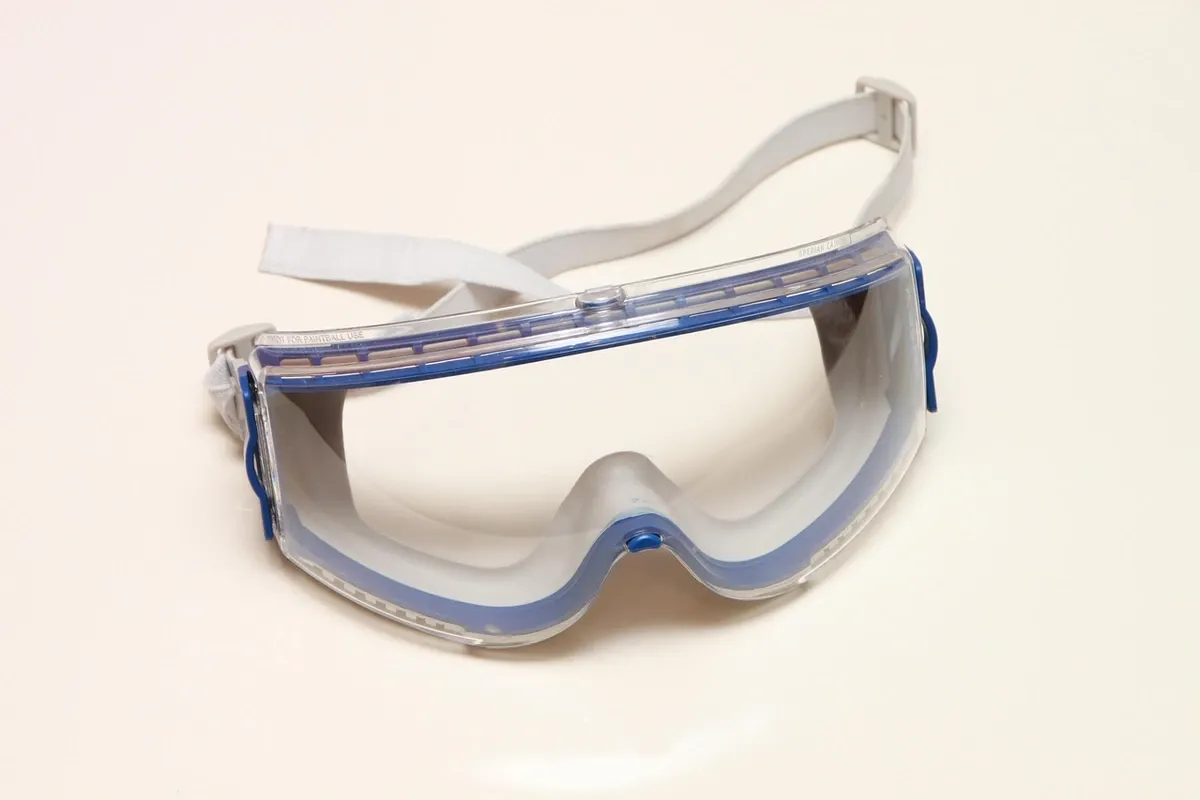
What to do instead: buy protection marked Z87+ under ANSI/ISEA Z87.1, which is the marking for the high-velocity impact test, and store it where the tool is rather than in a drawer. OSHA references that standard in 29 CFR 1910.133. The same logic applies to hearing protection, which goes on before the first cut rather than once the noise becomes unpleasant.
Treating finish rags as ordinary trash
Rags used with oil finishes can self-heat as the oil cures. In an apartment that is a genuine fire risk with a bin full of them.
What to do instead: follow the disposal instruction printed on that specific product's can, every time, without improvising a method you read somewhere else. The can is the only source that knows what is in the product.
Mistakes That Ruin the Project
Designing from nominal lumber sizes
A 2x4 measures 1-1/2 by 3-1/2 inches, and a 1x6 measures 3/4 by 5-1/2. The nominal name describes the rough green board; the finished dimensions are set by the PS 20 American Softwood Lumber Standard and have not changed since 1964.
What to do instead: measure the board you actually bought and design from that number. A plan built on a two-inch-thick 2x4 is out by a quarter inch at every joint, and the beginner conclusion is usually "my cuts are bad" when the cuts were fine.
Trusting a square that is not square
An inaccurate square produces work that is consistently wrong, which is much harder to diagnose than work that is randomly wrong.
What to do instead: run the flip test. Against a known straight edge, draw a line along the blade, flip the square to the other side of the same point, and draw again. If the lines diverge, the square is off by half the gap. Do this before the first project and again after the square has been dropped.
Measuring from a different reference each time
Flipping the board and measuring from whichever end is nearer accumulates error across a project, and it is invisible until assembly.
What to do instead: mark one face and one edge as your references and take every measurement from them. Where several parts must match, cut one, then use it as the pattern for the others rather than measuring each independently.
Gluing without a dry fit
Glue-up is the least reversible step and the worst time to discover a joint does not close.
What to do instead: assemble the whole thing with clamps and no glue, first. Check it sits flat and square, count that you have enough clamps, and then take it apart and repeat with glue. Also: more glue is not stronger, and a joint starved of clamp pressure is weaker than one that is properly closed. Simple builds like a wooden box or a step stool are where this habit is cheapest to learn.
Sanding by skipping grits
Jumping from coarse to fine leaves the coarse scratches in place, and they become obvious the moment a finish goes on.
What to do instead: work through in order without skipping a step, and sand until the previous grit's scratches are gone rather than for a number of minutes. Then remove the dust properly before finishing, because dust under a finish is permanent.
Applying finish to a surface that was not ready
Most finishing failures are surface preparation failures wearing a different hat: blotchy stain, visible scratches, dust nibs, a patch that will not take color.
What to do instead: test the finish on an offcut of the same board first, since different boards from the same stack take stain differently. Follow the product's own instructions for coats and recoat times, and check the label rather than a general rule for anything that will touch food, as the cutting board guide sets out.
Mistakes That Just Waste Money and Momentum
Buying tools before projects. The drawer of unused steel is the most common beginner spend, and it usually crowds out the two or three tools that would have been used constantly. The argument for buying in the other order is in the minimal tool kit.
Starting with a project that is too big. A first build should be finishable in a session or two. Ambition is not the problem; an unfinished project sitting in a shared apartment for six weeks is, and it is the single most common reason people stop.
Buying warped lumber because it was there. Sight down every board before it goes in the cart. Bow and twist do not sand out.
Working on a surface you cannot damage. Cutting on the dining table without a sacrificial board underneath is a deposit-sized mistake in a rental.
Skipping pilot holes. Screws near the end of a board split it, and the split usually happens on the last screw of the assembly.
Sanding indoors with no containment. Fine dust travels through a whole apartment and settles for hours. IARC classified wood dust as a Group 1 carcinogen in 1995, and a shared home means other people are in it too.
Expecting the first one to be good. It will not be, and that is not a mistake. It is the cost of entry, and it is why the first project should be cheap material. The starting sequence in woodworking without a garage is built on that assumption.
The Short Version
- Guards stay on. A sticking guard is a repair, not a technique.
- Never hand-hold a small piece into a blade. Cut it while it is part of a longer board.
- A table saw is not the safe option because it sits still. CPSC estimated 26,500 blade-contact injuries in 2017, about 10.7 percent of them amputations.
- Z87+ eye protection goes on for the quick cut too.
- Follow the can's instructions for oil-finish rag disposal.
- Design from actual lumber dimensions, not the nominal label.
- Test your square with the flip test before you trust it.
- Dry fit before glue, every time.
- Do not skip sanding grits, and clear the dust before finishing.
- Buy tools when a project needs them, and keep the first project small.
Frequently Asked Questions
What is the single most common beginner mistake? Measuring and marking errors, by volume. They are also the cheapest to fix, because the tools involved cost very little and the habits, one reference face and a verified square, take a day to adopt.
Is it a mistake to start with power tools instead of hand tools? No, but it changes what you have to get right. Power tools remove the effort and add the guard, PPE and work-holding requirements. In an apartment there is a separate reason to start by hand, which is that hand tools do not generate noise complaints.
How do I fix a project that came out crooked? Usually you do not, and trying is how a small error becomes a ruined piece. Work out which step introduced it, most often an inaccurate square or a shifting workpiece, then build the next one correctly. Keep the crooked one as the reference for what changed.
Do I really need to dry fit if the joint looks fine? Yes. Wood glue sets faster than a beginner assembles, and a joint that will not close is not something you want to discover with glue already on it.
Is buying used tools a beginner mistake? Not inherently. The risk is buying something you cannot yet assess: a plane with a cracked body or a saw that needs skills to bring back. Buying used is easier once you know what a good example of that tool feels like.